THE WRETCHED OF THE EARTH
By FRANTZ FANON, trans. Constance Farrington (New York: Grove Press, 1963)
CONCERNING VIOLENCE
 National liberation, national renaissance, the restoration of nationhood to the people, commonwealth: whatever may be the headings used or the new formulas introduced, decolonization is always a violent phenomenon. At whatever level we study it–relationships between individuals, new names for sports clubs, the human admixture at cocktail parties, in the police, on the directing boards of national or private banks–decolonization is quite simply the replacing of a certain “species” of men by another “species” of men. Without any period of transition, there is a total, complete, and absolute substitution. It is true that we could equally well stress the rise of a new nation, the setting up of a new state, its diplomatic relations, and its economic and political trends. But we have precisely chosen to speak of that kind of tabula rasa which characterizes at the outset all decolonization. Its unusual importance is that it constitutes, from the very first day, the minimum demands of the colonized. To tell the truth, the proof of success lies in a whole social structure being changed from the bottom up. The extraordinary importance of this change is that it is willed, called for, demanded. The need for this change exists in its crude state, impetuous and compelling, in the consciousness and in the
-35-
lives of the men and women who are colonized. But the possibility of this change is equally experienced in the form of a terrifying future in the consciousness of another “species” of men and women: the colonizers.
Decolonization, which sets out to change the order of the world, is, obviously, a program of complete disorder. But it cannot come as a result of magical practices, nor of a natural shock, nor of a friendly understanding. Decolonization, as we know, is a historical process: that is to say that it cannot be understood, it cannot become intelligible nor clear to itself except in the exact measure that we can discern the movements which give it historical form and content. Decolonization is the meeting of two forces, opposed to each other by their very nature, which in fact owe their originality to that sort of substantification which results from and is nourished by the situation in the colonies. Their first encounter was marked by violence and their existence together–that is to say the exploitation of the native by the settler–was carried on by dint of a great array of bayonets and cannons. The settler and the native are old acquaintances. In fact, the settler is right when he speaks of knowing “them” well. For it is the settler who has brought the native into existence and who perpetuates his existence. The settler owes the fact of his very existence, that is to say, his property, to the colonial system.
Decolonization never takes place unnoticed, for it influences individuals and modifies them fundamentally. It transforms spectators crushed with their inessentiality into privileged actors, with the grandiose glare of history’s floodlights upon them. It brings a natural rhythm into existence, introduced by new men, and with it a new language and a new humanity. Decolonization is the veritable creation of new men. But this creation owes nothing of its legitimacy to any supernatural power; the
-36-
“thing” which has been colonized becomes man during the same process by which it frees itself.
In decolonization, there is therefore the need of a complete calling in question of the colonial situation. If we wish to describe it precisely, we might find it in the wellknown words: “The last shall be first and the first last.” Decolonization is the putting into practice of this sentence. That is why, if we try to describe it, all decolonization is successful.
The naked truth of decolonization evokes for us the searing bullets and bloodstained knives which emanate from it. For if the last shall be first, this will only come to pass after a murderous and decisive struggle between the two protagonists. That affirmed intention to place the last at the head of things, and to make them climb at a pace (too quickly, some say) the well-known steps which characterize an organized society, can only triumph if we use all means to turn the scale, including, of course, that of violence.
You do not turn any society, however primitive it may be, upside down with such a program if you have not decided from the very beginning, that is to say from the actual formulation of that program, to overcome all the obstacles that you will come across in so doing. The native who decides to put the program into practice, and to become its moving force, is ready for violence at all times. From birth it is clear to him that this narrow world, strewn with prohibitions, can only be called in question by absolute violence.
The colonial world is a world divided into compartments. It is probably unnecessary to recall the existence of native quarters and European quarters, of schools for natives and schools for Europeans; in the same way we need not recall apartheid in South Africa. Yet, if we examine closely this system of compartments, we will at
-37-
least be able to reveal the lines of force it implies. This approach to the colonial world, its ordering and its geographical layout will allow us to mark out the lines on which a decolonized society will be reorganized.
The colonial world is a world cut in two. The dividing line, the frontiers are shown by barracks and police stations. In the colonies it is the policeman and the soldier who are the official, instituted go-betweens, the spokesmen of the settler and his rule of oppression. In capitalist societies the educational system, whether lay or clerical, the structure of moral reflexes handed down from father to son, the exemplary honesty of workers who are given a medal after fifty years of good and loyal service, and the affection which springs from harmonious relations and good behavior–all these aesthetic expressions of respect for the established order serve to create around the exploited person an atmosphere of submission and of inhibition which lightens the task of policing considerably. In the capitalist countries a multitude of moral teachers, counselors and “bewilderers” separate the exploited from those in power. In the colonial countries, on the contrary, the policeman and the soldier, by their immediate presence and their frequent and direct action maintain contact with the native and advise him by means of rifle butts and napalm not to budge. It is obvious here that the agents of government speak the language of pure force. The intermediary does not lighten the oppression, nor seek to hide the domination; he shows them up and puts them into practice with the clear conscience of an upholder of the peace; yet he is the bringer of violence into the home and into the mind of the native.
The zone where the natives live is not complementary to the zone inhabited by the settlers. The two zones are opposed, but not in the service of a higher unity. Obedient to the rules of pure Aristotelian logic, they both
-38-
follow the principle of reciprocal exclusivity. No conciliation is possible, for of the two terms, one is superfluous. The settlers’ town is a strongly built town, all made of stone and steel. It is a brightly lit town; the streets are covered with asphalt, and the garbage cans swallow all the leavings, unseen, unknown and hardly thought about. The settler’s feet are never visible, except perhaps in the sea; but there you’re never close enough to see them. His feet are protected by strong shoes although the streets of his town are clean and even, with no holes or stones. The settler’s town is a well-fed town, an easygoing town; its belly is always full of good things. The settlers’ town is a town of white people, of foreigners.
The town belonging to the colonized people, or at least the native town, the Negro village, the medina, the reservation, is a place of ill fame, peopled by men of evil repute. They are born there, it matters little where or how; they die there, it matters not where, nor how. It is a world without spaciousness; men live there on top of each other, and their huts are built one on top of the other. The native town is a hungry town, starved of bread, of meat, of shoes, of coal, of light. The native town is a crouching village, a town on its knees, a town wallowing in the mire. It is a town of niggers and dirty Arabs. The look that the native turns on the settler’s town is a look of lust, a look of envy; it expresses his dreams of possession–all manner of possession: to sit at the settler’s table, to sleep in the settler’s bed, with his wife if possible. The colonized man is an envious man. And this the settler knows very well; when their glances meet he ascertains bitterly, always on the defensive, “They want to take our place.” It is true, for there is no native who does not dream at least once a day of setting himself up in the settler’s place.
This world divided into compartments, this world cut
-39-
in two is inhabited by two different species. The originality of the colonial context is that economic reality, inequality, and the immense difference of ways of life never come to mask the human realities. When you examine at close quarters the colonial context, it is evident that what parcels out the world is to begin with the fact of belonging to or not belonging to a given race, a given species. In the colonies the economic substructure is also a superstructure. The cause is the consequence; you are rich because you are white, yon are white because you are rich. This is why Marxist analysis should always be slightly stretched every time we have to do with the colonial problem.
Everything up to and including the very nature of precapitalist society, so well explained by Marx, must here be thought out again. The serf is in essence different from the knight, but a reference to divine right is necessary to legitimize this statutory difference. In the colonies, the foreigner coming from another country imposed his rule by means of guns and machines. In defiance of his successful transplantation, in spite of his appropriation, the settler still remains a foreigner. It is neither the act of owning factories, nor estates, nor a bank balance which distinguishes the governing classes. The governing race is first and foremost those who come from elsewhere, those who are unlike the original inhabitants, “the others.”
The violence which has ruled over the ordering of the colonial world, which has ceaselessly drummed the rhythm for the destruction of native social forms and broken up without reserve the systems of reference of the economy, the customs of dress and external life, that same violence will be claimed and taken over by the native at the moment when, deciding to embody history in his own person, he surges into the forbidden quarters. To wreck the colonial world is henceforward a mental picture of action
-40-
which is very clear, very easy to understand and which may be assumed by each one of the individuals which constitute the colonized people. To break up the colonial world does not mean that after the frontiers have been abolished lines of communication will be set up between the two zones. The destruction of the colonial world is no more and no less that the abolition of one zone, its burial in the depths of the earth or its expulsion from the country.
The natives’ challenge to the colonial world is not a rational confrontation of points of view. It is not a treatise on the universal, but the untidy affirmation of an original idea propounded as an absolute. The colonial world is a Manichean world. It is not enough for the settler to delimit physically, that is to say with the help of the army and the police force, the place of the native. As if to show the totalitarian character of colonial exploitation the settler paints the native as a sort of quintessence of evil. * Native society is not simply described as a society lacking in values. It is not enough for the colonist to affirm that those values have disappeared from, or still better never existed in, the colonial world. The native is declared insensible to ethics; he represents not only the absence of values, but also the negation of values. He is, let us dare to admit, the enemy of values, and in this sense he is the absolute evil. He is the corrosive element, destroying all that comes near him; he is the deforming element, disfiguring all that has to do with beauty or morality; he is the depository of maleficent powers, the unconscious and irretrievable instrument of blind forces. Monsieur Meyer could thus state seriously in the French National Assembly that the Republic must not be prostituted by allowing
____________________
* We have demonstrated the mechanism of this Manichean world in Black Skin, White Masks ( New York: Grove Press, 1967).
-41-
the Algerian people to become part of it. All values, in fact, are irrevocably poisoned and diseased as soon as they are allowed in contact with the colonized race. The customs of the colonized people, their traditions, their myths — above all, their myths–are the very sign of that poverty of spirit and of their constitutional depravity. That is why we must put the DDT which destroys parasites, the bearers of disease, on the same level as the Christian religion which wages war on embryonic heresies and instincts, and on evil as yet unborn. The recession of yellow fever and the advance of evangelization form part of the same balance sheet. But the triumphant communiqués from the missions are in fact a source of information concerning the implantation of foreign influences in the core of the colonized people. I speak of the Christian religion, and no one need be astonished. The Church in the colonies is the white people’s Church, the foreigner’s Church. She does not call the native to God’s ways but to the ways of the white man, of the master, of the oppressor. And as we know, in this matter many are called but few chosen.
At times this Manicheism goes to its logical conclusion and dehumanizes the native, or to speak plainly, it turns him into an animal. In fact, the terms the settler uses when he mentions the native are zoological terms. He speaks of the yellow man’s reptilian motions, of the stink of the native quarter, of breeding swarms, of foulness, of spawn, of gesticulations. When the settler seeks to describe the native fully in exact terms he constantly refers to the bestiary. The European rarely hits on a picturesque style; but the native, who knows what is in the mind of the settler, guesses at once what he is thinking of. Those hordes of vital statistics, those hysterical masses, those faces bereft of all humanity, those distended bodies which are like nothing on earth, that mob without beginning or
-42-
end, those children who seem to belong to nobody, that laziness stretched out in the sun, that vegetative rhythm of life–all this forms part of the colonial vocabulary. General de Gaulle speaks of “the yellow multitudes” and François Mauriac of the black, brown, and yellow masses which soon will be unleashed. The native knows all this, and laughs to himself every time he spots an allusion to the animal world in the other’s words. For he knows that he is not an animal; and it is precisely at the moment he realizes his humanity that he begins to sharpen the weapons with which he will secure its victory.
As soon as the native begins to pull on his moorings, and to cause anxiety to the settler, he is handed over to well-meaning souls who in cultural congresses point out to him the specificity and wealth of Western values. But every time Western values are mentioned they produce in the native a sort of stiffening or muscular lockjaw. During the period of decolonization, the natives’s reason is appealed to. He is offered definite values, he is told frequently that decolonization need not mean regression, and that he must put his trust in qualities which are welltried, solid, and highly esteemed. But it so happens that when the native hears a speech about Western culture he pulls out his knife–or at least he makes sure it is within reach. The violence with which the supremacy of white values is affirmed and the aggressiveness which has permeated the victory of these values over the ways of life and of thought of the native mean that, in revenge, the native laughs in mockery when Western values are mentioned in front of him. In the colonial context the settler only ends his work of breaking in the native when the latter admits loudly and intelligibly the supremacy of the white man’s values. In the period of decolonization, the colonized masses mock at these very values, insult them, and vomit them up.
-43-
This phenomenon is ordinarily masked because, during the period of decolonization, certain colonized intellectuals have begun a dialogue with the bourgeoisie of the colonialist country. During this phase, the indigenous population is discerned only as an indistinct mass. The few native personalities whom the colonialist bourgeois have come to know here and there have not sufficient influence on that immediate discernment to give rise to nuances. On the other hand, during the period of liberation, the colonialist bourgeoisie looks feverishly for contacts with the elite and it is with these elite that the familiar dialogue concerning values is carried on. The colonialist bourgeoisie, when it realizes that it is impossible for it to maintain its domination over the colonial countries, decides to carry out a rearguard action with regard to culture, values, techniques, and so on. Now what we must never forget is that the immense majority of colonized peoples is oblivious to these problems. For a colonized people the most essential value, because the most concrete, is first and foremost the land: the land which will bring them bread and, above all, dignity. But this dignity has nothing to do with the dignity of the human individual: for that human individual has never heard tell of it. All that the native has seen in his country is that they can freely arrest him, beat him, starve him: and no professor of ethics, no priest has ever come to be beaten in his place, nor to share their bread with him. As far as the native is concerned, morality is very concrete; it is to silence the settler’s defiance, to break his flaunting violence–in a word, to put him out of the picture. The wellknown principle that all men are equal will be illustrated in the colonies from the moment that the native claims that he is the equal of the settler. One step more, and he is ready to fight to be more than the settler. In fact, he has already decided to eject him and to take his place; as
-44-
we see it, it is a whole material and moral universe which is breaking up. The intellectual who for his part has followed the colonialist with regard to the universal abstract will fight in order that the settler and the native may live together in peace in a new world. But the thing he does not see, precisely because he is permeated by colonialism and all its ways of thinking, is that the settler, from the moment that the colonial context disappears, has no longer any interest in remaining or in co-existing. It is not by chance that, even before any negotiation * between the Algerian and French governments has taken place, the European minority which calls itself “liberal” has already made its position clear: it demands nothing more nor less than twofold citizenship. By setting themselves apart in an abstract manner, the liberals try to force the settler into taking a very concrete jump into the unknown. Let us admit it, the settler knows perfectly well that no phraseology can be a substitute for reality.
Thus the native discovers that his life, his breath, his beating heart are the same as those of the settler. He finds out that the settler’s skin is not of any more value than a native’s skin; and it must be said that this discovery shakes the world in a very necessary manner. All the new, revolutionary assurance of the native stems from it. For if, in fact, my life is worth as much as the settler’s, his glance no longer shrivels me up nor freezes me, and his voice no longer turns me into stone. I am no longer on tenterhooks in his presence; in fact, I don’t give a damn for him. Not only does his presence no longer trouble me, but I am already preparing such efficient ambushes for him that soon there will be no way out but that of flight.
We have said that the colonial context is characterized by the dichotomy which it imposes upon the whole peo-
____________________
* Fanon is writing in 1961.–Trans.
-45-
ple. Decolonization unifies that people by the radical decision to remove from it its heterogeneity, and by unifying it on a national, sometimes a racial, basis. We know the fierce words of the Senegalese patriots, referring to the maneuvers of their president, Senghor: “We have demanded that the higher posts should be given to Africans; and now Senghor is Africanizing the Europeans.” That is to say that the native can see clearly and immediately if decolonization has come to pass or not, for his minimum demands are simply that the last shall be first.
But the native intellectual brings variants to this petition, and, in fact, he seems to have good reasons: higher civil servants, technicians, specialists–all seem to be needed. Now, the ordinary native interprets these unfair promotions as so many acts of sabotage, and he is often heard to declare: “It wasn’t worth while, then, our becoming independent…”
In the colonial countries where a real struggle for freedom has taken place, where the blood of the people has flowed and where the length of the period of armed warfare has favored the backward surge of intellectuals toward bases grounded in the people, we can observe a genuine eradication of the superstructure built by these intellectuals from the bourgeois colonialist environment. The colonialist bourgeoisie, in its narcissistic dialogue, expounded by the members of its universities, had in fact deeply implanted in the minds of the colonized intellectual that the essential qualities remain eternal in spite of all the blunders men may make: the essential qualities of the West, of course. The native intellectual accepted the cogency of these ideas, and deep down in his brain you could always find a vigilant sentinel ready to defend the Greco-Latin pedestal. Now it so happens that during the struggle for liberation, at the moment that the native intellectual comes into touch again with his people, this
-46-
artificial sentinel is turned into dust. All the Mediterranean values–the triumph of the human individual, of clarity, and of beauty–become lifeless, colorless knickknacks. All those speeches seem like collections of dead words; those values which seemed to uplift the soul are revealed as worthless, simply because they have nothing to do with the concrete conflict in which the people is engaged.
Individualism is the first to disappear. The native intellectual had learnt from his masters that the individual ought to express himself fully. The colonialist bourgeoisie had hammered into the native’s mind the idea of a society of individuals where each person shuts himself up in his own subjectivity, and whose only wealth is individual thought. Now the native who has the opportunity to return to the people during the struggle for freedom will discover the falseness of this theory. The very forms of organization of the struggle will suggest to him a different vocabulary. Brother, sister, friend–these are words outlawed by the colonialist bourgeoisie, because for them my brother is my purse, my friend is part of my scheme for getting on. The native intellectual takes part, in a sort of auto-da-fé, in the destruction of all his idols: egoism, recrimination that springs from pride, and the childish stupidity of those who always want to have the last word. Such a colonized intellectual, dusted over by colonial culture, will in the same way discover the substance of village assemblies, the cohesion of people’s committees, and the extraordinary fruitfulness of local meetings and groupments. Henceforward, the interests of one will be the interests of all, for in concrete fact everyone will be discovered by the troops, everyone will be massacred–or everyone will be saved. The motto “look out for yourself,” the atheist’s method of salvation, is in this context forbidden.
Self-criticism has been much talked about of late, but
-47-
few people realize that it is an African institution. Whether in the djemaas * of northern Africa or in the meetings of western Africa, tradition demands that the quarrels which occur in a village should be settled in public. It is communal self-criticism, of course, and with a note of humor, because everybody is relaxed, and because in the last resort we all want the same things. But the more the intellectual imbibes the atmosphere of the people, the more completely he abandons the habits of calculation, of unwonted silence, of mental reservations, and shakes off the spirit of concealment. And it is true that already at that level we can say that the community triumphs, and that it spreads its own light and its own reason.
But it so happens sometimes that decolonization occurs in areas which have not been sufficiently shaken by the struggle for liberation, and there may be found those same know-all, smart, wily intellectuals. We find intact in them the manners and forms of thought picked up during their association with the colonialist bourgeoisie. Spoilt children of yesterday’s colonialism and of today’s national governments, they organize the loot of whatever national resources exist. Without pity, they use today’s national distress as a means of getting on through scheming and legal robbery, by import-export combines, limited liability companies, gambling on the stock exchange, or unfair promotion. They are insistent in their demands for the nationalization of commerce, that is to say the reservation of markets and advantageous bargains for nationals only. As far as doctrine is concerned, they proclaim the pressing necessity of nationalizing the robbery of the nation. In this arid phase of national life, the so-called period of austerity, the success of their depredations is
____________________
* Village assemblies.–Trans.
-48-
swift to call forth the violence and anger of the people. For this same people, poverty-stricken yet independent, comes very quickly to possess a social conscience in the African and international context of today; and this the petty individualists will quickly learn.
In order to assimilate and to experience the oppressor’s culture, the native has had to leave certain of his intellectual possessions in pawn. These pledges include his adoption of the forms of thought of the colonialist bourgeoisie. This is very noticeable in the inaptitude of the native intellectual to carry on a two-sided discussion; for he cannot eliminate himself when confronted with an object or an idea. On the other hand, when once he begins to militate among the people he is struck with wonder and amazement; he is literally disarmed by their good faith and honesty. The danger that will haunt him continually is that of becoming the uncritical mouthpiece of the masses; he becomes a kind of yes-man who nods assent at every word coming from the people, which he interprets as considered judgments. Now, the fellah, the unemployed man, the starving native do not lay a claim to the truth; they do not say that they represent the truth, for they are the truth.
Objectively, the intellectual behaves in this phase like a common opportunist. In fact he has not stopped maneuvering. There is never any question of his being either rejected or welcomed by the people. What they ask is simply that all resources should be pooled. The inclusion of the native intellectual in the upward surge of the masses will in this case be differentiated by a curious cult of detail. That is not to say that the people are hostile to analysis; on the contrary, they like having things explained to them, they are glad to understand a line of argument and they like to see where they are going. But at the beginning of his association with the people the native
-49-
intellectual over-stresses details and thereby comes to forget that the defeat of colonialism is the real object of the struggle. Carried away by the multitudinous aspects of the fight, he tends to concentrate on local tasks, performed with enthusiasm but almost always too solemnly. He fails to see the whole of the movement all the time. He introduces the idea of special disciplines, of specialized functions, of departments within the terrible stone crusher, the fierce mixing machine which a popular revolution is. He is occupied in action on a particular front, and it so happens that he loses sight of the unity of the movement. Thus, if a local defeat is inflicted, he may well be drawn into doubt, and from thence to despair. The people, on the other hand, take their stand from the start on the broad and inclusive positions of bread and the land: how can we obtain the land, and bread to eat? And this obstinate point of view of the masses, which may seem shrunken and limited, is in the end the most worthwhile and the most efficient mode of procedure.
The problem of truth ought also to be considered. In every age, among the people, truth is the property of the national cause. No absolute verity, no discourse on the purity of the soul, can shake this position. The native replies to the living lie of the colonial situation by an equal falsehood. His dealings with his fellow-nationals are open; they are strained and incomprehensible with regard to the settlers. Truth is that which hurries on the break-up of the colonialist regime; it is that which promotes the emergence of the nation; it is all that protects the natives, and ruins the foreigners. In this colonialist context there is no truthful behavior: and the good is quite simply that which is evil for “them.”
Thus we see that the primary Manicheism which governed colonial society is preserved intact during the period of decolonization; that is to say that the settler never
-50-
ceases to be the enemy, the opponent, the foe that must be overthrown. The oppressor, in his own sphere, starts the process, a process of domination, of exploitation and of pillage, and in the other sphere the coiled, plundered creature which is the native provides fodder for the process as best he can, the process which moves uninterruptedly from the banks of the colonial territory to the palaces and the docks of the mother country. In this becalmed zone the sea has a smooth surface, the palm tree stirs gently in the breeze, the waves lap against the pebbles, and raw materials are ceaselessly transported, justifying the presence of the settler: and all the while the native, bent double, more dead than alive, exists interminably in an unchanging dream. The settler makes history; his life is an epoch, an Odyssey. He is the absolute beginning: “This land was created by us”; he is the unceasing cause: “If we leave, all is lost, and the country will go back to the Middle Ages.” Over against him torpid creatures, wasted by fevers, obsessed by ancestral customs, form an almost inorganic background for the innovating dynamism of colonial mercantilism.
The settler makes history and is conscious of making it. And because he constantly refers to the history of his mother country, he clearly indicates that he himself is the extension of that mother country. Thus the history which he writes is not the history of the country which he plunders but the history of his own nation in regard to all that she skims off, all that she violates and starves.
The immobility to which the native is condemned can only be called in question if the native decides to put an end to the history of colonization–the history of pillage -and to bring into existence the history of the nation–the history of decolonization.
A world divided into compartments, a motionless, Manicheistic world, a world of statues: the statue of the
-51-
general who carried out the conquest, the statue of the engineer who built the bridge; a world which is sure of itself, which crushes with its stones the backs flayed by whips: this is the colonial world. The native is a being hemmed in; apartheid is simply one form of the division into compartments of the colonial world. The first thing which the native learns is to stay in his place, and not to go beyond certain limits. This is why the dreams of the native are always of muscular prowess; his dreams are of action and of aggression. I dream I am jumping, swimming, running, climbing; I dream that I burst out laughing, that I span a river in one stride, or that I am followed by a flood of motorcars which never catch up with me. During the period of colonization, the native never stops achieving his freedom from nine in the evening until six in the morning.
The colonized man will first manifest this aggressiveness which has been deposited in his bones against his own people. This is the period when the niggers beat each other up, and the police and magistrates do not know which way to turn when faced with the astonishing waves of crime in North Africa. We shall see later how this phenomenon should be judged. * When the native is confronted with the colonial order of things, he finds he is in a state of permanent tension. The settler’s world is a hostile world, which spurns the native, but at the same time it is a world of which he is envious. We have seen that the native never ceases to dream of putting himself in the place of the settler–not of becoming the settler but of substituting himself for the settler. This hostile world, ponderous and aggressive because it fends off the colonized masses with all the harshness it is capable of, represents not merely a hell from which the swiftest flight
____________________
* See the section: “Colonial War and Mental Disorders.”
-52-
possible is desirable, but also a paradise close at hand which is guarded by terrible watchdogs.
The native is always on the alert, for since he can only make out with difficulty the many symbols of the colonial world, he is never sure whether or not he has crossed the frontier. Confronted with a world ruled by the settler, the native is always presumed guilty. But the native’s guilt is never a guilt which he accepts; it is rather a kind of curse, a sort of sword of Damocles, for, in his innermost spirit, the native admits no accusation. He is overpowered but not tamed; he is treated as an inferior but he is not convinced of his inferiority. He is patiently waiting until the settler is off his guard to fly at him. The native’s muscles are always tensed. You can’t say that he is terrorized, or even apprehensive. He is in fact ready at a moment’s notice to exchange the role of the quarry for that of the hunter. The native is an oppressed person whose permanent dream is to become the persecutor. The symbols of social order–the police, the bugle calls in the barracks, military parades and the waving flags–are at one and the same time inhibitory and stimulating: for they do not convey the message “Don’t dare to budge”; rather, they cry out “Get ready to attack.” And, in fact, if the native had any tendency to fall asleep and to forget, the settler’s hauteur and the settler’s anxiety to test the strength of the colonial system would remind him at every turn that the great showdown cannot be put off indefinitely. That impulse to take the settler’s place implies a tonicity of muscles the whole time; and in fact we know that in certain emotional conditions the presence of an obstacle accentuates the tendency toward motion.
The settler-native relationship is a mass relationship. The settler pits brute force against the weight of numbers. He is an exhibitionist. His preoccupation with security makes him remind the native out loud that there he alone
-53-
is master. The settler keeps alive in the native an anger which he deprives of outlet; the native is trapped in the tight links of the chains of colonialism. But we have seen that inwardly the settler can only achieve a pseudo petrification. The native’s muscular tension finds outlet regularly in bloodthirsty explosions–in tribal warfare, in feuds between septs, and in quarrels between individuals.
Where individuals are concerned, a positive negation of common sense is evident. While the settler or the policeman has the right the livelong day to strike the native, to insult him and to make him crawl to them, you will see the native reaching for his knife at the slightest hostile or aggressive glance cast on him by another native; for the last resort of the native is to defend his personality vis-à-vis his brother. Tribal feuds only serve to perpetuate old grudges buried deep in the memory. By throwing himself with all his force into the vendetta, the native tries to persuade himself that colonialism does not exist, that everything is going on as before, that history continues. Here on the level of communal organizations we clearly discern the well-known behavior patterns of avoidance. It is as if plunging into a fraternal bloodbath allowed them to ignore the obstacle, and to put off till later the choice, nevertheless inevitable, which opens up the question of armed resistance to colonialism. Thus collective autodestruction in a very concrete form is one of the ways in which the native’s muscular tension is set free. All these patterns of conduct are those of the death reflex when faced with danger, a suicidal behavior which proves to the settler (whose existence and domination is by them all the more justified) that these men are not reasonable human beings. In the same way the native manages to by-pass the settler. A belief in fatality removes all blame from the oppressor; the cause of misfortunes and of poverty is attributed to God: He is Fate. In this way
-54-
the individual accepts the disintegration ordained by God, bows down before the settler and his lot, and by a kind of interior restabilization acquires a stony calm.
Meanwhile, however, life goes on, and the native will strengthen the inhibitions which contain his aggressiveness by drawing on the terrifying myths which are so frequently found in underdeveloped communities. There are maleficent spirits which intervene every time a step is taken in the wrong direction, leopard-men, serpent-men, six-legged dogs, zombies–a whole series of tiny animals or giants which create around the native a world of prohibitions, of barriers and of inhibitions far more terrifying than the world of the settler. This magical superstructure which permeates native society fulfills certain well-defined functions in the dynamism of the libido. One of the characteristics of underdeveloped societies is in fact that the libido is first and foremost the concern of a group, or of the family. The feature of communities whereby a man who dreams that he has sexual relations with a woman other than his own must confess it in public and pay a fine in kind or in working days to the injured husband or family is fully described by ethnologists. We may note in passing that this proves that the so-called prehistoric societies attach great importance to the unconscious.
The atmosphere of myth and magic frightens me and so takes on an undoubted reality. By terrifying me, it integrates me in the traditions and the history of my district or of my tribe, and at the same time it reassures me, it gives me a status, as it were an identification paper. In underdeveloped countries the occult sphere is a sphere belonging to the community which is entirely under magical jurisdiction. By entangling myself in this inextricable network where actions are repeated with crystalline inevitability, I find the everlasting world which belongs to
-55-
me, and the perenniality which is thereby affirmed of the world belonging to us. Believe me, the zombies are more terrifying than the settlers; and in consequence the problem is no longer that of keeping oneself right with the colonial world and its barbed-wire entanglements, but of considering three times before urinating, spitting, or going out into the night.
The supernatural, magical powers reveal themselves as essentially personal; the settler’s powers are infinitely shrunken, stamped with their alien origin. We no longer really need to fight against them since what counts is the frightening enemy created by myths. We perceive that all is settled by a permanent confrontation on the phantasmic plane.
It has always happened in the struggle for freedom that such a people, formerly lost in an imaginary maze, a prey to unspeakable terrors yet happy to lose themselves in a dreamlike torment, such a people becomes unhinged, reorganizes itself, and in blood and tears gives birth to very real and immediate action. Feeding the moudjahidines, * posting sentinels, coming to the help of families which lack the bare necessities, or taking the place of a husband who has been killed or imprisoned: such are the concrete tasks to which the people is called during the struggle for freedom.
In the colonial world, the emotional sensitivity of the native is kept on the surface of his skin like an open sore which flinches from the caustic agent; and the psyche shrinks back, obliterates itself and finds outlet in muscular demonstrations which have caused certain very wise men to say that the native is a hysterical type. This sensitive emotionalism, watched by invisible keepers who are how-
____________________
* Highly-trained soldiers who are completely dedicated to the Moslem cause.–Trans.
-56-
ever in unbroken contact with the core of the personality, will find its fulfillment through eroticism in the driving forces behind the crisis’ dissolution.
On another level we see the native’s emotional sensibility exhausting itself in dances which are more or less ecstatic. This is why any study of the colonial world should take into consideration the phenomena of the dance and of possession. The native’s relaxation takes precisely the form of a muscular orgy in which the most acute aggressivity and the most impelling violence are canalized, transformed, and conjured away. The circle of the dance is a permissive circle: it protects and permits. At certain times on certain days, men and women come together at a given place, and there, under the solemn eye of the tribe, fling themselves into a seemingly unorganized pantomime, which is in reality extremely systematic, in which by various means–shakes of the head, bending of the spinal column, throwing of the whole body backward -may be deciphered as in an open book the huge effort of a community to exorcise itself, to liberate itself, to explain itself. There are no limits–inside the circle. The hillock up which you have toiled as if to be nearer to the moon; the river bank down which you slip as if to show the connection between the dance and ablutions, cleansing and purification–these are sacred places. There are no limits–for in reality your purpose in coming together is to allow the accumulated libido, the hampered aggressivity, to dissolve as in a volcanic eruption. Symbolical killings, fantastic rides, imaginary mass murders–all must be brought out. The evil humors are undammed, and flow away with a din as of molten lava.
One step further and you are completely possessed. In fact, these are actually organized séances of possession and exorcism; they include vampirism, possession by djinns, by zombies, and by Legba, the famous god of the voodoo.
-57-
This disintegrating of the personality, this splitting and dissolution, all this fulfills a primordial function in the organism of the colonial world. When they set out, the men and women were impatient, stamping their feet in a state of nervous excitement; when they return, peace has been restored to the village; it is once more calm and unmoved.
During the struggle for freedom, a marked alienation from these practices is observed. The native’s back is to the wall, the knife is at his throat (or, more precisely, the electrode at his genitals): he will have no more call for his fancies. After centuries of unreality, after having wallowed in the most outlandish phantoms, at long last the native, gun in hand, stands face to face with the only forces which contend for his life–the forces of colonialism. And the youth of a colonized country, growing up in an atmosphere of shot and fire, may well make a mock of, and does not hesitate to pour scorn upon the zombies of his ancestors, the horses with two heads, the dead who rise again, and the djinns who rush into your body while you yawn. The native discovers reality and transforms it into the pattern of his customs, into the practice of violence and into his plan for freedom.
We have seen that this same violence, though kept very much on the surface all through the colonial period, yet turns in the void. We have also seen that it is canalized by the emotional outlets of dance and possession by spirits; we have seen how it is exhausted in fratricidal combats. Now the problem is to lay hold of this violence which is changing direction. When formerly it was appeased by myths and exercised its talents in finding fresh ways of committing mass suicide, now new conditions will make possible a completely new line of action.
Nowadays a theoretical problem of prime importance is being set, on the historical plane as well as on the level of
-58-
political tactics, by the liberation of the colonies: when can one affirm that the situation is ripe for a movement of national liberation? In what form should it first be manifested? Because the various means whereby decolonization has been carried out have appeared in many different aspects, reason hesitates and refuses to say which is a true decolonization, and which a false. We shall see that for a man who is in the thick of the fight it is an urgent matter to decide on the means and the tactics to employ: that is to say, how to conduct and organize the movement. If this coherence is not present there is only a blind will toward freedom, with the terribly reactionary risks which it entails.
What are the forces which in the colonial period open up new outlets and engender new aims for the violence of colonized peoples? In the first place there are the political parties and the intellectual or commercial elites. Now, the characteristic feature of certain political structures is that they proclaim abstract principles but refrain from issuing definite commands. The entire action of these nationalist political parties during the colonial period is action of the electoral type: a string of philosophicopolitical dissertations on the themes of the rights of peoples to self-determination, the rights of man to freedom from hunger and human dignity, and the unceasing affirmation of the principle: “One man, one vote.” The national political parties never lay stress upon the necessity of a trial of armed strength, for the good reason that their objective is not the radical overthrowing of the system. Pacifists and legalists, they are in fact partisans of order, the new order–but to the colonialist bourgeoisie they put bluntly enough the demand which to them is the main one: “Give us more power.” On the specific question of violence, the elite are ambiguous. They are violent in their words and reformist in their attitudes.
-59-
When the nationalist political leaders say something, they make quite clear that they do not really think it.
This characteristic on the part of the nationalist political parties should be interpreted in the light both of the make-up of their leaders and the nature of their followings. The rank-and-file of a nationalist party is urban. The workers, primary schoolteachers, artisans, and small shopkeepers who have begun to profit–at a discount, to be sure–from the colonial setup, have special interests at heart. What this sort of following demands is the betterment of their particular lot: increased salaries, for example. The dialogue between these political parties and colonialism is never broken off. Improvements are discussed, such as full electoral representation, the liberty of the press, and liberty of association. Reforms are debated. Thus it need not astonish anyone to notice that a large number of natives are militant members of the branches of political parties which stem from the mother country. These natives fight under an abstract watchword: “Government by the workers,” and they forget that in their country it should be nationalist watchwords which are first in the field. The native intellectual has clothed his aggressiveness in his barely veiled desire to assimilate himself to the colonial world. He has used his aggressiveness to serve his own individual interests.
Thus there is very easily brought into being a kind of class of affranchised slaves, or slaves who are individually free. What the intellectual demands is the right to multiply the emancipated, and the opportunity to organize a genuine class of emancipated citizens. On the other hand, the mass of the people have no intention of standing by and watching individuals increase their chances of success. What they demand is not the settler’s position of status, but the settler’s place. The immense majority of natives want the settler’s farm. For them, there is no question of
-60-
entering into competition with the settler. They want to take his place.
The peasantry is systematically disregarded for the most part by the propaganda put out by the nationalist parties. And it is clear that in the colonial countries the peasants alone are revolutionary, for they have nothing to lose and everything to gain. The starving peasant, outside the class system, is the first among the exploited to discover that only violence pays. For him there is no compromise, no possible coming to terms; colonization and decolonization are simply a question of relative strength. The exploited man sees that his liberation implies the use of all means, and that of force first and foremost. When in 1956, after the capitulation of Monsieur Guy Mollet to the settlers in Algeria, the Front de Libération Nationale, in a famous leaflet, stated that colonialism only loosens its hold when the knife is at its throat, no Algerian really found these terms too violent. The leaflet only expressed what every Algerian felt at heart: colonialism is not a thinking machine, nor a body endowed with reasoning faculties. It is violence in its natural state, and it will only yield when confronted with greater violence.
At the decisive moment, the colonialist bourgeoisie, which up till then has remained inactive, comes into the field. It introduces that new idea which is in proper parlance a creation of the colonial situation: non-violence. In its simplest form this non-violence signifies to the intellectual and economic elite of the colonized country that the bourgeoisie has the same interests as they and that it is therefore urgent and indispensable to come to terms for the public good. Non-violence is an attempt to settle the colonial problem around a green baize table, before any regrettable act has been performed or irreparable gesture made, before any blood has been shed. But if the masses, without, waiting for the chairs to be arranged around me
-61-
baize table, listen to their own voice and begin committing outrages and setting fire to buildings, the elite and the nationalist bourgeois parties will be seen rushing to the colonialists to exclaim, “This is very serious! We do not know how it will end; we must find a solution–some sort of compromise.”
This idea of compromise is very important in the phenomenon of decolonization, for it is very far from being a simple one. Compromise involves the colonial system and the young nationalist bourgeoisie at one and the same time. The partisans of the colonial system discover that the masses may destroy everything. Blown-up bridges, ravaged farms, repressions, and fighting harshly disrupt the economy. Compromise is equally attractive to the nationalist bourgeoisie, who since they are not clearly aware of the possible consequences of the rising storm, are genuinely afraid of being swept away by this huge hurricane and never stop saying to the settlers: “We are still capable of stopping the slaughter; the masses still have confidence in us; act quickly if you do not want to put everything in jeopardy.” One step more, and the leader of the nationalist party keeps his distance with regard to that violence. He loudly proclaims that he has nothing to do with these Mau-Mau, these terrorists, these throat-slitters. At best, he shuts himself off in a no man’s land between the terrorists and the settlers and willingly offers his services as go-between; that is to say, that as the settlers cannot discuss terms with these Mau-Mau, he himself will be quite willing to begin negotiations. Thus it is that the rear guard of the national struggle, that very party of people who have never ceased to be on the other side in the fight, find themselves somersaulted into the van of negotiations and compromise–precisely because that party has taken very good care never to break contact with colonialism.
-62-
Before negotiations have been set afoot, the majority of nationalist parties confine themselves for the most part to explaining and excusing this “savagery.” They do not assert that the people have to use physical force, and it sometimes even happens that they go so far as to condemn, in private, the spectacular deeds which are declared to be hateful by the press and public opinion in the mother country. The legitimite excuse for this ultra-conservative policy is the desire to see things in an objective light; but this traditional attitude of the native intellectual and of the leaders of the nationalist parties is not, in reality, in the least objective. For in fact they are not at all convinced that this impatient violence of the masses is the most efficient means of defending their own interests. Moreover, there are some individuals who are convinced of the ineffectiveness of violent methods; for them, there is no doubt about it, every attempt to break colonial oppression by force is a hopeless effort, an attempt at suicide, because in the innermost recesses of their brains the settler’s tanks and airplanes occupy a huge place. When they are told “Action must be taken,” they see bombs raining down on them, armored cars coming at them on every path, machine-gunning and police action… and they sit quiet. They are beaten from the start. There is no need to demonstrate their incapacity to triumph by violent methods; they take it for granted in their everyday life and in their political maneuvers. They have remained in the same childish position as Engels took up in his famous polemic with that monument of puerility, Monsieur Duhring:
In the same way that Robinson [Crusoe] was able to obtain a sword, we can just as well suppose that [Man] Friday might appear one fine morning with a loaded revolver in his hand, and from then on the whole relationship of violence is reversed: Man Friday gives the orders and Crusoe is obliged
-63-
to work…. Thus, the revolver triumphs over the sword, and even the most childish believer in axioms will doubtless form the conclusion that violence is not a simple act of will, but needs for its realization certain very concrete preliminary conditions, and in particular the implements of violence; and the more highly developed of these implements will carry the day against primitive ones. Moreover, the very fact of the ability to produce such weapons signifies that the producer of highly developed weapons, in everyday speech the arms manufacturer, triumphs over the producer of primitive weapons. To put it briefly, the triumph of violence depends upon the production of armaments, and this in its turn depends on production in general, and thus…on economic strength, on the economy of the State, and in the last resort on the material means which that violence commands. *
In fact, the leaders of reform have nothing else to say than: “With what are you going to fight the settlers? With your knives? Your shotguns?”
It is true that weapons are important when violence comes into play, since all finally depends on the distribution of these implements. But it so happens that the liberation of colonial countries throws new light on the subject. For example, we have seen that during the Spanish campaign, which was a very genuine colonial war, Napoleon, in spite of an army which reached in the offensives of the spring of 1810 the huge figure of 400,000 men, was forced to retreat. Yet the French army made the whole of Europe tremble by its weapons of war, by the bravery of its soldiers, and by the military genius of its leaders. Face to face with the enormous potentials of the Napoleonic troops, the Spaniards, inspired by an unshakeable national ardor, rediscovered the famous methods of guerilla warfare which, twenty-five years before, the American militia had tried out on the English forces. But the
____________________
* Friedrich Engels: Anti-Dühring, Part II, Chapter III, “Theory of Violence”, p. 199.
-64-
native’s guerilla warfare would be of no value as opposed to other means of violence if it did not form a new element in the worldwide process of competition between trusts and monopolies.
In the early days of colonization, a single column could occupy immense stretches of country: the Congo, Nigeria, the Ivory Coast, and so on. Today, however, the colonized countries’ national struggle crops up in a completely new international situation. Capitalism, in its early days, saw in the colonies a source of raw materials which, once turned into manufactured goods, could be distributed on the European market. After a phase of accumulation of capital, capitalism has today come to modify its conception of the profit-earning capacity of a commercial enterprise. The colonies have become a market. The colonial population is a customer who is ready to buy goods; consequently, if the garrison has to be perpetually reinforced, if buying and selling slackens off, that is to say if manufactured and finished goods can no longer be exported, there is clear proof that the solution of military force must be set aside. A blind domination founded on slavery is not economically speaking worthwhile for the bourgeoisie of the mother country. The monopolistic group within this bourgeoisie does not support a government whose policy is solely that of the sword. What the factoryowners and finance magnates of the mother country expect from their government is not that it should decimate the colonial peoples, but that it should safeguard with the help of economic conventions their own “legitimate interests.”
Thus there exists a sort of detached complicity between capitalism and the violent forces which blaze up in colonial territory. What is more, the native is not alone against the oppressor, for indeed there is also the political and diplomatic support of progressive countries and peo-
-65-
ples. But above all there is competition, that pitiless war which financial groups wage upon each other. A Berlin Conference was able to tear Africa into shreds and divide her up between three or four imperial flags. At the moment, the important thing is not whether such-and-such a region in Africa is under French or Belgian sovereignty, but rather that the economic zones are respected. Today, wars of repression are no longer waged against rebel sultans; everything is more elegant, less bloodthirsty; the liquidation of the Castro regime will be quite peaceful. They do all they can to strangle Guinea and they eliminate Mossadegh. Thus the nationalist leader who is frightened of violence is wrong if he imagines that colonialism is going to “massacre all of us.” The military will of course go on playing with tin soldiers which date from the time of the conquest, but higher finance will soon bring the truth home to them.
This is why reasonable nationalist political parties are asked to set out their claims as clearly as possible, and to seek with their colonialist opposite numbers, calmly and without passion, for a solution which will take the interests of both parties into consideration. We see that if this nationalist reformist tendency which often takes the form of a kind of caricature of trade unionism decides to take action, it will only do so in a highly peaceful fashion, through stoppages of work in the few industries which have been set up in the towns, mass demonstrations to cheer the leaders, and the boycotting of buses or of imported commodities. All these forms of action serve at one and the same time to bring pressure to bear on the forces of colonialism, and to allow the people to work off their energy. This practice of therapy by hibernation, this sleep-cure used on the people, may sometimes be successful; thus out of the conference around the green baize table comes the political selectiveness which enables Mon-
-66-
Mon, the president of the Republic of Gabon, to state in all seriousness on his arrival in Paris for an official visit: “Gabon is independent, but between Gabon and France nothing has changed; everything goes on as before.” In fact, the only change is that Monsieur M’ba is president of the Gabonese Republic and that he is received by the president of the French Republic.
The colonialist bourgeoisie is helped in its work of calming down the natives by the inevitable religion. All those saints who have turned the other cheek, who have forgiven trespasses against them, and who have been spat on and insulted without shrinking are studied and held up as examples. On the other hand, the elite of the colonial countries, those slaves set free, when at the head of the movement inevitably end up by producing an ersatz conflict. They use their brothers’ slavery to shame the slavedrivers or to provide an ideological policy of quaint humanitarianism for their oppressors’ financial competitors. The truth is that they never make any real appeal to the aforesaid slaves; they never mobilize them in concrete terms. On the contrary, at the decisive moment (that is to say, from their point of view the moment of indecision) they brandish the danger of a “mass mobilization” as the crucial weapon which would bring about as if by magic the “end of the colonial regime.” Obviously there are to be found at the core of the political parties and among their leaders certain revolutionaries who deliberately turn their backs upon the farce of national independence. But very quickly their questionings, their energy, and their anger obstruct the party machine; and these elements are gradually isolated, and then quite simply brushed aside. At this moment, as if there existed a dialectic concomitance, the colonialist police will fall upon them. With no security in the towns, avoided by the militants of their former party and rejected by its
-67-
leaders, these undesirable firebrands will be stranded in county districts. Then it is that they will realize bewilderedly that the peasant masses catch on to what they have to say immediately, and without delay ask them the question to which they have not yet prepared the answer: “When do we start?”
This meeting of revolutionaries coming from the towns and country dwellers will be dealt with later on. For the moment we must go back to the political parties, in order to show the nature of their action, which is all the same progressive. In their speeches the political leaders give a name to the nation. In this way the native’s demands are given shape.
There is however no definite subject matter and no political or social program. There is a vague outline or skeleton, which is nevertheless national in form, what we describe as “minimum requirements.” The politicians who make speeches and who write in the nationalist newspapers make the people dream dreams. They avoid the actual overthrowing of the state, but in fact they introduce into their readers’ or hearers’ consciousness the terrible ferment of subversion. The national or tribal language is often used. Here, once again, dreams are encouraged, and the imagination is let loose outside the bounds of the colonial order; and sometimes these politicians speak of “We Negroes, we Arabs,” and these terms which are so profoundly ambivalant take on during the colonial epoch a sacramental signification. The nationalist politicians are playing with fire: for, as an African leader recently warned a group of young intellectuals, “Think well before you speak to the masses, for they flare up quickly.” This is one of the terrible tricks that destiny plays in the colonies.
When a political leader calls a mass meeting, we may say that there is blood in the air. Yet the same leader very often is above all anxious to “make a show” of force, so
-68-
that in fact he need not use it. But the agitation which ensues, the coming and going, the listening to speeches, seeing the people assembled in one place, with the police all around, the military demonstrations, arrests, and the deportation of the leaders–all this hubbub makes the people think that the moment has come for them to take action. In these times of instability the political parties multiply their appeals to the left for calm, while on their right they scan the horizon, trying to make out the liberal intentions of colonialism.
In the same way the people make use of certain episodes in the life of the community in order to hold themselves ready and to keep alive their revolutionary zeal. For example, the gangster who holds up the police set on to track him down for days on end, or who dies in single combat after having killed four or five policemen, or who commits suicide in order not to give away his accomplices –these types light the way for the people, form the blueprints for action and become heroes. Obviously, it’s a waste of breath to say that such-and-such a hero is a thief, a scoundrel, or a reprobate. If the act for which he is prosecuted by the colonial authorities is an act exclusively directed against a colonialist person or colonialist property, the demarcation line is definite and manifest. The process of identification is automatic.
We must also notice in this ripening process the role played by the history of the resistance at the time of the conquest. The great figures of the colonized people are always those who led the national resistance to invasion. Behanzin, Soundiata, Samory, Abdel Kader–all spring again to life with peculiar intensity in the period which comes directly before action. This is the proof that the people are getting ready to begin to go forward again, to put an end to the static period begun by colonization, and to make history.
-69-
The uprising of the new nation and the breaking down of colonial structures are the result of one of two causes: either of a violent struggle of the people in their own right, or of action on the part of surrounding colonized peoples which acts as a brake on the colonial regime in question.
A colonized people is not alone. In spite of all that colonialism can do, its frontiers remain open to new ideas and echoes from the world outside. It discovers that violence is in the atmosphere, that it here and there bursts out, and here and there sweeps away the colonial regime –that same violence which fulfills for the native a role that is not simply informatory, but also operative. The great victory of the Vietnamese people at Dien Bien Phu is no longer, strictly speaking, a Vietnamese victory. Since July, 1954, the question which the colonized peoples have asked themselves has been, “What must be done to bring about another Dien Bien Phu? How can we manage it?” Not a single colonized individual could ever again doubt the possibility of a Dien Bien Phu; the only problem was how best to use the forces at their disposal, how to organize them, and when to bring them into action. This encompassing violence does not work upon the colonized people only; it modifies the attitude of the colonialists who become aware of manifold Dien Bien Phus. This is why a veritable panic takes hold of the colonialist governments in turn. Their purpose is to capture the vanguard, to turn the movement of liberation toward the right, and to disarm the people: quick, quick, let’s decolonize. Decolonize the Congo before it turns into another Algeria. Vote the constitutional framework for all Africa, create the French Communauté, renovate that same Communauté, but for God’s sake let’s decolonize quick…. And they decolonize at such a rate that they impose independence on Houphouët-Boigny. To the strategy of Dien Bien Phu, defined by the colonized peoples, the colonialist re-
-70-
plies by the strategy of encirclement–based on the respect of the sovereignty of states.
But let us return to that atmosphere of violence, that violence which is just under the skin. We have seen that in its process toward maturity many leads are attached to it, to control it and show it the way out. Yet in spite of the metamorphoses which the colonial regime imposes upon it in the way of tribal or regional quarrels, that violence makes its way forward, and the native identifies his enemy and recognizes all his misfortunes, throwing all the exacerbated might of his hate and anger into this new channel. But how do we pass from the atmosphere of violence to violence in action? What makes the lid blow off? There is first of all the fact that this development does not leave the settler’s blissful existence intact. The settler who “understands” the natives is made aware by several straws in the wind showing that something is afoot. “Good” natives become scarce; silence falls when the oppressor approaches; sometimes looks are black, and attitudes and remarks openly aggressive. The nationalist parties are astir, they hold a great many meetings, the police are increased and reinforcements of soldiers are brought in. The settlers, above all the farmers isolated on their land, are the first to become alarmed. They call for energetic measures.
The authorities do in fact take some spectacular measures. They arrest one or two leaders, they organize military parades and maneuvers, and air force displays. But the demonstrations and warlike exercises, the smell of gunpowder which now fills the atmosphere, these things do not make the people draw back. Those bayonets and cannonades only serve to reinforce their aggressiveness. The atmosphere becomes dramatic, and everyone wishes to show that he is ready for anything. And it is in these circumstances that the guns go off by themselves, for nerves are jangled, fear reigns and everyone is trigger-happy. A
-71-
single commonplace incident is enough to start the machine-gunning: Sétif in Algeria, the Central Quarries in Morocco, Moramanga in Madagascar.
The repressions, far from calling a halt to the forward rush of national consciousness, urge it on. Mass slaughter in the colonies at a certain stage of the embryonic development of consciousness increases that consciousness, for the hecatombs are an indication that between oppressors and oppressed everything can be solved by force. It must be remarked here that the political parties have not called for armed insurrection, and have made no preparations for such an insurrection. All these repressive measures, all those actions which are a result of fear are not within the leaders’ intentions: they are overtaken by events. At this moment, then, colonialism may decide to arrest the nationalist leaders. But today the governments of colonized countries know very well that it is extremely dangerous to deprive the masses of their leaders; for then the people, unbridled, fling themselves into jacqueries, mutinies, and “brutish murders.” The masses give free rein to their “bloodthirsty instincts” and force colonialism to free their leaders, to whom falls the difficult task of bringing them back to order. The colonized people, who have spontaneously brought their violence to the colossal task of destroying the colonial system, will very soon find themselves with the barren, inert slogan “Release X or Y.” * Then colonialism will release these men, and hold discussions with them. The time for dancing in the streets has come.
In certain circumstances, the party political machine may remain intact. But as a result of the colonialist repression and of the spontaneous reaction of the people the parties find themselves out-distanced by their militants.
____________________
* It may happen that the arrested leader is in fact the authentic mouthpiece of the colonized masses. In this case colonialism will make use of his period of detention to try to launch new leaders.
-72-
The violence of the masses is vigorously pitted against the military forces of the occupying power, and the situation deteriorates and comes to a head. Those leaders who are free remain, therefore, on the touchline. They have suddenly become useless, with their bureaucracy and their reasonable demands; yet we see them, far removed from events, attempting the crowning imposture–that of “speaking in the name of the silenced nation.” As a general rule, colonialism welcomes this godsend with open arms, tranforms these “blind mouths” into spokesmen, and in two minutes endows them with independence, on condition that they restore order.
So we see that all parties are aware of the power of such violence and that the question is not always to reply to it by a greater violence, but rather to see how to relax the tension.
What is the real nature of this violence? We have seen that it is the intuition of the colonized masses that their liberation must, and can only, be achieved by force. By what spiritual aberration do these men, without technique, starving and enfeebled, confronted with the military and economic might of the occupation, come to believe that violence alone will free them? How can they hope to triumph?
It is because violence (and this is the disgraceful thing) may constitute, in so far as it forms part of its system, the slogan of a political party. The leaders may call on the people to enter upon an armed struggle. This problematical question has to be thought over. When militarist Germany decides to settle its frontier disputes by force, we are not in the least surprised; but when the people of Angola, for example, decide to take up arms, when the Algerian people reject all means which are not violent, these are proofs that something has happened or is happening at this very moment. The colonized races, those
-73-
slaves of modern times, are impatient. They know that this apparent folly alone can put them out of reach of colonial oppression. A new type of relations is established in the world. The underdeveloped peoples try to break their chains, and the extraordinary thing is that they succeed. It could be argued that in these days of sputniks it is ridiculous to die of hunger; but for the colonized masses the argument is more down-to-earth. The truth is that there is no colonial power today which is capable of adopting the only form of contest which has a chance of succeeding, namely, the prolonged establishment of large forces of occupation.
As far as their internal situation is concerned, the colonialist countries find themselves faced with contradictions in the form of working-class demands which necessitate the use of their police forces. As well, in the present international situation, these countries need their troops to protect their regimes. Finally there is the wellknown myth of liberating movements directed from Moscow. In the regime’s panic-stricken reasoning, this signifies “If that goes on, there is a risk that the communists will turn the troubles to account and infiltrate into these parts.”
In the native’s eagerness, the fact that he openly brandishes the threat of violence proves that he is conscious of the unusual character of the contemporary situation and that he means to profit by it. But, still on the level of immediate experience, the native, who has seen the modern world penetrate into the furthermost corners of the bush, is most acutely aware of all the things he does not possess. The masses by a sort of (if we may say so) childlike process of reasoning convince themselves that they have been robbed of all these things. That is why in certain underdeveloped countries the masses forge ahead very quickly, and realize two or three years after independ-
-74-
ence that they have been frustrated, that “it wasn’t worth while” fighting, and that nothing could really change. In 1789, after the bourgeois revolution, the smallest French peasants benefited substantially from the upheaval. But it is a commonplace to observe and to say that in the majority of cases, for 95 per cent of the population of underdeveloped countries, independence brings no immediate change. The enlightened observer takes note of the existence of a kind of masked discontent, like the smoking ashes of a burnt-down house after the fire has been put out, which still threaten to burst into flames again.
So they say that the natives want to go too quickly. Now, let us never forget that only a very short time ago they complained of their slowness, their laziness, and their fatalism. Already we see that violence used in specific ways at the moment of the struggle for freedom does not magically disappear after the ceremony of trooping the national colors. It has all the less reason for disappearing since the reconstruction of the nation continues within the framework of cutthroat competition between capitalism and socialism.
This competition gives an almost universal dimension to even the most localized demands. Every meeting held, every act of represson committed, reverberates in the international arena. The murders of Sharpeville shook public opinion for months. In the newspapers, over the wavelengths, and in private conversations Sharpeville has become a symbol. It was through Sharpeville that men and women first became acquainted with the problem of apartheid in South Africa. Moreover, we cannot believe that demagogy alone is the explanation for the sudden interest the big powers show in the petty affairs of underdeveloped regions. Each jacquerie, each act of sedition in the Third World makes up part of a picture framed by the Cold War. Two men are beaten up in Salisbury, and at
-75-
once the whole of a bloc goes into action, talks about those two men, and uses the beating-up incident to bring up the particular problem of Rhodesia, linking it, moreover, with the whole African question and with the whole question of colonized people. The other bloc however is equally concerned in measuring by the magnitude of the campaign the local weaknesses of its system. Thus the colonized peoples realize that neither clan remains outside local incidents. They no longer limit themselves to regional horizons, for they have caught on to the fact that they live in an atmosphere of international stress.
When every three months or so we hear that the Sixth or Seventh Fleet is moving toward such-and-such a coast; when Khrushchev threatens to come to Castro’s aid with rockets; when Kennedy decides upon some desperate solution for the Laos question, the colonized person or the newly independent native has the impression that whether he wills it or not he is being carried away in a kind of frantic cavalcade. In fact, he is marching in it already. Let us take, for example, the case of the governments of recently liberated countries. The men at the head of affairs spend two-thirds of their time in watching the approaches and trying to anticipate the dangers which threaten them, and the remaining one-third of their time in working for their country. At the same time, they search for allies. Obedient to the same dialectic, the national parties of opposition leave the paths of parliamentary behavior. They also look for allies to support them in their ruthless ventures into sedition. The atmosphere of violence, after having colored all the colonial phase, continues to dominate national life, for as we have already said, the Third World is not cut off from the rest. Quite the contrary, it is at the middle of the whirlpool. This is why the statesmen of underdeveloped countries keep up
-76-
indefinitely the tone of aggressiveness and exasperation in their public speeches which in the normal way ought to have disappeared. Herein, also, may be found the reasons for that lack of politeness so often spoken of in connection with newly established rulers. But what is less visible is the extreme courtesy of these same rulers in their contacts with their brothers or their comrades. Discourtesy is first and foremost a manner to be used in dealings with the others, with the former colonists who come to observe and to investigate. The “ex-native” too often gets the impression that these reports are already written. The photos which illustrate the article are simply a proof that one knows what one is talking about, and that one has visited the country. The report intends to verify the evidence: everything’s going badly out there since we left. Frequently reporters complain of being badly received, of being forced to work under bad conditions and of being fenced round by indifference or hostility: all this is quite normal. The nationalist leaders know that international opinion is formed solely by the Western press. Now, when a journalist from the West asks us questions, it is seldom in order to help us. In the Algerian war, for example, even the most liberal of the French reporters never ceased to use ambiguous terms in describing our struggle. When we reproached them for this, they replied in all good faith that they were being objective. For the native, objectivity is always directed against him. We may in the same way come to understand the new tone which swamped international diplomacy at the United Nations General Assembly in September, 1960. The representatives of the colonial countries were aggressive and violent, and carried things to extremes, but the colonial peoples did not find that they exaggerated. The radicalism of the African spokesmen brought the abcess to a head and showed up the inad-
-77-
missible nature of the veto and of the dialogue between the great powers, and above all the tiny role reserved for the Third World.
Diplomacy, as inaugurated by the newly independent peoples, is no longer an affair of nuances, of implications, and of hypnotic passes. For the nation’s spokesmen are responsible at one and the same time for safeguarding the unity of the nation, the progress of the masses toward a state of well-being and the right of all peoples to bread and liberty. Thus it is a diplomacy which never stops moving, a diplomacy which leaps ahead, in strange contrast to the motionless, petrified world of colonization. And when Mr. Khrushchev brandishes his shoe at the United Nations, or thumps the table with it, there’s not a single exnative, nor any representative of an underdeveloped country, who laughs. For what Mr. Khrushchev shows the colonized countries which are looking on is that he, the moujik, who moreover is the possessor of spacerockets, treats these miserable capitalists in the way that they deserve. In the same way, Castro sitting in military uniform in the United Nations Organization does not scandalize the underdeveloped countries. What Castro demonstrates is the consciousness he has of the continuing existence of the rule of violence. The astonishing thing is that he did not come into the UNO with a machine-gun; but if he had, would anyone have minded? All the jacqueries and desperate deeds, all those bands armed with cutlesses or axes find their nationality in the implacable struggle which opposes socialism and capitalism.
In 1945, the 45,000 dead at Sétif could pass unnoticed; in 1947, the 90,000 dead in Madagascar could be the subject of a simple paragraph in the papers; in 1952, the 200,000 victims of the repression in Kenya could meet with relative indifference. This was because the international contradictions were not sufficiently distinct. Already the
-78-
Korean and Indo-Chinese wars had begun a new phase. But it is above all Budapest and Suez which constitute the decisive moments of this confrontation.
Strengthened by the unconditional support of the socialist countries, the colonized peoples fling themselves with whatever arms they have against the impregnable citadel of colonialism. If this citadel is invulnerable to knives and naked fists, it is no longer so when we decide to take into account the context of the Cold War.
In this fresh juncture, the Americans take their role of patron of international captialism very seriously. Early on, they advise the European countries to decolonize in a friendly fashion. Later on, they do not hesitate to proclaim first the respect for and then the support of the principle of “Africa for the Africans.” The United States is not afraid today of stating officially that they are the defenders of the right of all peoples to self-determination. Mr. Mennen Williams’ last journey is only the illustration of the consciousness which the Americans have that the Third World ought not to be sacrificed. From then on we understand why the violence of the native is only hopeless if we compare it in the abstract to the military machine of the oppressor. On the other hand, if we situate that violence in the dynamics of the international situation, we see at once that it constitutes a terrible menace for the oppressor. Persistent jacqueries and Mau-Mau disturbance unbalance the colony’s economic life but do not endanger the mother country. What is more important in the eyes of imperialism is the opportunity for socialist propaganda to infiltrate among the masses and to contaminate them. This is already a serious danger in the cold war; but what would happen to that colony in case of real war, riddled as it is by murderous guerillas?
Thus capitalism realizes that its military strategy has everything to lose by the outbreak of nationalist wars.
-79-
Again, within the framework of peaceful co-existence, all colonies are destined to disappear, and in the long run neutralism is destined to be respected by capitalism. What must at all costs be avoided is strategic insecurity: the breakthrough of enemy doctrine into the masses and the deeprooted hatred of millions of men. The colonized peoples are very well aware of these imperatives which rule international political life; for this reason even those who thunder denunciations of violence take their decisions and act in terms of this universal violence. Today, peaceful coexistence between the two blocs provokes and feeds violence in the colonial countries. Tomorrow, perhaps we shall see the shifting of that violence after the complete liberation of the colonial territories. Perhaps we will see the question of minorities cropping up. Already certain minority groups do not hesitate to preach violent methods for resolving their problems and it is not by chance (so the story runs) that in consequence Negro extremists in the United States organize a militia and arm themselves. It is not by chance, either, that in the so-called free world there exist committees for the defense of Jewish minorities in the USSR, nor an accident if General de Gaulle in one of his orations sheds tears over the millions of Moslems oppressed by Communist dictatorship. Both capitalism and imperialism are convinced that the struggle against racialism and the movements toward national freedom are purely and simply directed by remote control, fomented from outside. So they decide to use that very efficacious tactic, the Radio Free Europe station, voice of the committee for the aid of overruled minorities…. They practice anti-colonialism, as did the French colonels in Algeria when they carried on subversive warfare with the SAS * or the psychological services. They “use the people
____________________
* Section Administrative Speciale: An officers’ corps whose task was to strengthen contact with the Algerians in non-military matters.
-80-
against the people.” We have seen with what results.
This atmosphere of violence and menaces, these rockets brandished by both sides, do not frighten nor deflect the colonized peoples. We have seen that all their recent history has prepared them to understand and grasp the situation. Between the violence of the colonies and that peaceful violence that the world is steeped in, there is a kind of complicit agreement, a sort of homogeneity. The colonized peoples are well adapted to this atmosphere; for once, they are up to date. Sometimes people wonder that the native, rather than give his wife a dress, buys instead a transistor radio. There is no reason to be astonished. The natives are convinced that their fate is in the balance, here and now. They live in the atmosphere of doomsday, and they consider that nothing ought to be let pass unnoticed. That is why they understand very well Phouma and Phoumi, Lumumba and Tshombe, Ahidjo and Moumie, Kenyatta, and the men who are pushed forward regularly to replace him. They understand all these figures very well, for they can unmask the forces working behind them. The native and the underdeveloped man are today political animals in the most universal sense of the word.
It is true to say that independence has brought moral compensation to colonized peoples, and has established their dignity. But they have not yet had time to elaborate a society, or to build up and affirm values. The warming, light-giving center where man and citizen develop and enrich their experience in wider and still wider fields does not yet exist. Set in a kind of irresolution, such men persuade themselves fairly easily that everything is going to be decided elsewhere, for everybody, at the same time. As for the political leaders, when faced with this situation, they first hesitate and then choose neutralism.
There is plenty to be said on the subject of neutralism. Some equate it with a sort of tainted mercantilism which
-81-
consists of taking what it can get from both sides. In fact, neutralism, a state of affairs created by the cold war, if it allows underdeveloped countries to receive economic help from both sides, does not allow either party to aid underdeveloped areas to the extent that is necessary. Those literally astronomical sums of money which are invested in military research, those engineers who are transformed into technicians of nuclear war, could in the space of fifteen years raise the standard of living of underdeveloped countries by 60 per cent. So we see that the true interests of underdeveloped countries do not lie in the protraction nor in the accentuation of this cold war. But it so happens that no one asks their advice. Therefore, when they can, they cut loose from it. But can they really remain outside it? At this very moment, France is trying out her atomic bombs in Africa. Apart from the passing of motions, the holding of meetings and the shattering of diplomatic relations, we cannot say that the peoples of Africa have had much influence, in this particular sector, on France’s attitude.
Neutralism produces in the citizen of the Third World a state of mind which is expressed in everyday life by a fearlessness and an ancestral pride strangely resembling defiance. The flagrant refusal to compromise and the tough will that sets itself against getting tied up are reminiscent of the behavior of proud, poverty-stricken adolescents, who are always ready to risk their necks in order to have the last word. All this leaves Western observers dumbfounded, for to tell the truth there is a glaring divergence between what these men claim to be and what they have behind them. These countries without tramways, without troops, and without money have no justification for the bravado that they display in broad daylight. Undoubtedly, they are impostors. The Third World often gives the impression that it rejoices in sensation and that it must have
-82-
its weekly dose of crises. These men at the head of empty countries, who talk too loud, are most irritating. You’d like to shut them up. But, on the contrary, they are in great demand. They are given bouquets; they are invited to dinner. In fact, we quarrel over who shall have them. And this is neutralism. They are 98 per cent illiterate, but they are the subject of a huge body of literature. They travel a great deal: the governing classes and students of underdeveloped countries are gold mines for airline companies. African and Asian officials may in the same month follow a course on socialist planning in Moscow and one on the advantages of the liberal economy in London or at Columbia University. African trade-union leaders leap ahead at a great rate in their own field. Hardly have they been appointed to posts in managerial organizations than they decide to form themselves into autonomous bodies. They haven’t the requisite fifty years experience of practical trade-unionism in the framework of an industrial country, but they already know that non-political trade-unionism doesn’t make sense. They haven’t come to grips with the bourgeois machine, nor developed their consciousness in the class struggle; but perhaps this isn’t necessary. Perhaps. We shall see that this will to sum everything up, which caricatures itself often in facile internationalism, is one of the most fundamental characteristics of underdeveloped countries.
Let us return to considering the single combat between native and settler. We have seen that it takes the form of an armed and open struggle. There is no lack of historical examples: Indo-China, Indonesia, and of course North Africa. But what we must not lose sight of is that this struggle could have broken out anywhere, in Guinea as well as Somaliland, and moreover today it could break out in every place where colonialism means to stay on, in Angola, for example. The existence of an armed struggle
-83-
shows that the people are decided to trust to violent methods only. He of whom they* The sentence is easily completed. During the phase of insurrection, each settler reasons on a basis of simple arithmetic. This logic does not surprise the other settlers, but it is important to point out that it does not surprise the natives either. To begin with, the affirmation of the principle “It’s them or us” does not constitute a paradox, since colonialism, as we have seen, is in fact the organization of a Manichean world, a world divided up into compartments. And when in laying down precise methods the settler asks each member of the oppressing minority to shoot down 30 or 100 or 200 natives, he sees that nobody shows any indignation and that the whole problem is to decide whether it can be done all at once or by-stages. † have never stopped saying that the only language he understands is that of force, decides to give utterance by force. In fact, as always, the settler has shown him the way he should take if he is to become free. The argument the native chooses has been furnished by the settler, and by an ironic turning of the tables it is the native who now affirms that the colonialist understands nothing but force. The colonial regime owes its legitimacy to force and at no time tries to hide this aspect of things. Every statue, whether of Faidherbe or of Lyautey, of Bugeaud or of Sergeant Blandan–all these conquistadors perched on colonial soil do not cease from proclaiming one and the same thing: “We are here by the force of bayonets….”
This chain of reasoning which presumes very arithmeti-
____________________
* This refers to Mirabeau’s famous saying: “I am here by the will of the People; I shall leave only by the force of bayonets.”–Trans. †
It is evident that this vacuum cleaning destroys the very thing that they want to preserve. Sartre points this out when he says: “In short by the very fact of repeating them [concerning racist ideas] it is revealed that the simultaneous union of all against the natives is unrealizable. Such union only recurs from time to time and moreover it can only come into being as an active groupment in order to massacre the natives–an absurd though perpetual temptation to the settlers, which even if it was feasible would only succeed in abolishing colonization at one blow.” (Critique de la Raison Dialectique, p. 346.)
-84-
cally the disappearance of the colonized people does not leave the native overcome with moral indignation. He has always known that his duel with the settler would take place in the arena. The native loses no time in lamentations, and he hardly ever seeks for justice in the colonial framework. The fact is that if the settler’s logic leaves the native unshaken, it is because the latter has practically stated the problem of his liberation in identical terms: “We must form ourselves into groups of two hundred or five hundred, and each group must deal with a settler.” It is in this manner of thinking that each of the protagonists begins the struggle.
For the native, this violence represents the absolute line of action. The militant is also a man who works. The questions that the organization asks the militant bear the mark of this way of looking at things: “Where have you worked? With whom? What have you accomplished? “The group requires that each individual perform an irrevocable action. In Algeria, for example, where almost all the men who called on the people to join in the national struggle were condemned to death or searched for by the French police, confidence was proportional to the hopelessness of each case. You could be sure of a new recruit when he could no longer go back into the colonial system. This mechanism, it seems, had existed in Kenya among the Mau-Mau, who required that each member of the group should strike a blow at the victim. Each one was thus personally responsible for the death of that victim. To work means to work for the death of the settler. This assumed
-85-
responsibility for violence allows both strayed and outlawed members of the group to come back again and to find their place once more, to become integrated. Violence is thus seen as comparable to a royal pardon. The colonized man finds his freedom in and through violence. This rule of conduct enlightens the agent because it indicates to him the means and the end. The poetry of Césaire takes on in this precise aspect of violence a prophetic significance. We may recall one of the most decisive pages of his tragedy where the Rebel (indeed!) explains his conduct:
THE REBEL (harshly):
My name–an offense; my Christian name–humiliation; my status–a rebel; my age–the stone age.
THE MOTHER:
My race–the human race. My religion–brotherhood.
THE REBEL:
My race: that of the fallen. My religion…but it’s not you that will show it to me with your disarmament….
’tis I myself, with my rebellion and my poor fists clenched and my woolly head….
(Very calm): I remember one November day; it was hardly six months ago…. The master came into the cabin in a cloud of smoke like an April moon. He was flexing his short muscular arms–he was a very good master–and he was rubbing his little dimpled face with his fat fingers. His blue eyes were smiling and he couldn’t get the honeyed words out of his month quick enough. “The kid will be a decent fellow,” he said looking at me, and he said other pleasant things too, the master–that you had to start very early, that twenty years was not too much to make a good Christian and a good slave, a steady, devoted boy, a good commander’s chaingang captain, sharp-eyed and strong-armed. And all that man saw of my son’s cradle was that it was the cradle of a chaingang captain.
-86-
We crept in knife in hand…
THE MOTHER:
Alas, you’ll die for it.
THE REBEL:
Killed…. I killed him with my own hands….
Yes, ’twas a fruitful death, a copious death….
It was night. We crept among the sugar canes.
The knives sang to the stars, but we did not heed the stars.
The sugar canes scarred our faces with streams of green blades.
THE MOTHER:
And I had dreamed of a son to close his mother’s eyes.
THE REBEL:
But I chose to open my son’s eyes upon another sun.
THE MOTHER:
O my son, son of evil and unlucky death–
THE REBEL:
Mother of living and splendid death,
THE MOTHER:
Because he has hated too much,
THE REBEL:
Because he has too much loved.
THE MOTHER:
Spare me, I am choking in your bonds. I bleed from your wounds.
THE REBEL:
And the world does not spare me…. There is not anywhere in the world a poor creature who’s been lynched or tortured in whom I am not murdered and humiliated…
THE MOTHER:
God of Heaven, deliver him!
THE REBEL:
My heart, thou wilt not deliver me from all that I remember…
It was an evening in November…
-87-
And suddenly shouts lit up the silence;
We had attacked, we the slaves; we, the dung underfoot, we the animals with patient hooves,
We were running like madmen; shots rang out…4We were striking. Blood and sweat cooled and refreshed us. We were striking where the shouts came from, and the shouts became more strident and a great clamor rose from the east: it was the outhouses burning and the flames flickered sweetly on our cheeks.
Then was the assault made on the master’s house. They were firing from the windows. We broke in the doors.
The master’s room was wide open. The master’s room was brilliantly lighted, and the master was there, very calm… and our people stopped dead…it was the master…I went in. “It’s you,” he said, very calm.
It was I, even I, and I told him so, the good slave, the faithful slave, the slave of slaves, and suddenly his eyes were like two cockroaches, frightened in the rainy season…I struck, and the blood spurted; that is the only baptism that I remember today. *
It is understandable that in this atmosphere, daily life becomes quite simply impossible. You can no longer be a fellah, a pimp, or an alcoholic as before. The violence of the colonial regime and the counter-violence of the native balance each other and respond to each other in an extraordinary reciprocal homogeneity. This reign of violence will be the more terrible in proportion to the size of the implantation from the mother country. The development of violence among the colonized people will be proportionate to the violence exercised by the threatened colonial regime. In the first phase of this insurrectional period, the home governments are the slaves of the settlers, and these settlers seek to intimidate the natives and their home gov-
____________________
* Aimé Césaire, Les Armes Miraculeuscs (Et les chiens se taisaient), pp. 133-37.
-88-
emments at one and the same time. They use the same methods against both of them. The assassination of the Mayor of Evian, in its method and motivation, is identifiable with the assassination of Ali Boumendjel. For the settlers, the alternative is not between Algérie algérienne and Algérie française but between an independent Algeria and a colonial Algeria, and anything else is mere talk or attempts at treason. The settler’s logic is implacable and one is only staggered by the counter-logic visible in the behavior of the native insofar as one has not clearly understood beforehand the mechanisms of the settler’s ideas. From the moment that the native has chosen the methods of counter-violence, police reprisals automatically call forth reprisals on the side of the nationalists. However, the results are not equivalent, for machine-gunning from airplanes and bombardments from the fleet go far beyond in horror and magnitude any answer the natives can make. This recurring terror de-mystifies once and for all the most estranged members of the colonized race. They find out on the spot that all the piles of speeches on the equality of human beings do not hide the commonplace fact that the seven Frenchmen killed or wounded at the Col de Sakamody kindles the indignation of all civilized consciences, whereas the sack of the douars * of Guergour and of the dechras of Djerah and the massacre of whole populations–which had merely called forth the Sakamody ambush as a reprisal–all this is of not the slightest importance. Terror, counter-terror, violence, counter-violence: that is what observers bitterly record when they describe the circle of hate, which is so tenacious and so evident in Algeria.
In all armed straggles, there exists what we might call the point of no return. Almost always it is marked off by
____________________
* Temporary village for the use of shepherds.–Trans.
-89-
a huge and all-inclusive repression which engulfs all sectors of the colonized people. This point was reached in Algeria in 1955 with the 12,000 victims of Phillippeville, and in 1956 with Lacoste’s instituting of urban and rural militias. †
____________________
† We must go back to this period in order to judge the importance of this decision on the part of the French government in Algeria. Thus we may read in “Résistance Algérienne,” No. 4, dated 28th March 1957, the following: “In reply to the wish expressed by the General Assembly of the United Nations, the French Government has now decided to create urban militias in Algeria. ‘Enough blood has been spilled’ was whatthe United Nations said; Lacoste replies ‘Let us form militias.’ ‘Cease fire,’ advised UNO; Lacoste vociferates, ‘We must arm the civilians.’ Whereas the two parties face-to-face with each other were on the recommendation of the United Nations invited to contact each other with a view to coming to an agreement and finding a peaceful and democratic solution, Lacoste decrees that henceforward every European will be armed and should open fire on any person who seems to him suspect. It was then agreed (in the Assembly) that savage and iniquitous repression verging on genocide ought at all costs to be opposed by the authorities: but Lacoste replies ‘Let us systematize the repression and organize the Algerian manhunt.’ And, symbolically, he entrusts the military with civil powers, and gives military powers to civilians. The ring is closed. In the middle, the Algerian, disarmed, famished, tracked down, jostled, struck, lynched, will soon be slaughtered as a suspect. Today, in Algeria, there is not a single Frenchman who is not authorized and even invited to use his weapons. There is not a single Frenchman, in Algeria, one month after the appeal for calm made by UNO, who is not permitted, and obliged to search out, investigate and pursue suspects.
“One month after the vote on the final motion of the General Assembly of the United Nations, there is not one European in Algeria who is not party to the most frightful work of extermination of modern times. A democratic solution? Right, Lacoste concedes; let’s begin by exterminating the Algerians, and to do that, let’s arm the civilians and give them carte blanche. The Paris press, on the whole, has welcomed the creation of these armed groups with reserve. Fascist militias, they’ve been called. Yes; but on the individual level, on the plane of human rights, what is fascism if not colonialism when rooted in a traditionally colonialist country? The opinion has been advanced that they are systematically legalized and commended; but does not the body of Algeria bear for the last one hundred and thirty years wounds which gape still wider, more numerous and more deepseated than ever? ‘Take care,’ advises Monsieur Kenne-Vignes, member of parliament for the MRP, ‘do we not by the creation of these militias risk seeing the gap widen between the two communities in Algeria?’ Yes; but is not colonial status simply the organized reduction to slavery of a whole people? The Algerian revolution is precisely the affirmed contestation of that slavery and that abyss. The Algerian revolution speaks to the occupying nation and says: ‘Take your fangs out of the bleeding flesh of Algeria! Let the people of Algeria speak!’
“The creation of militias, they say, will lighten the tasks of the Army. It will free certain units whose mission will be to protect the Moroccan and Tunisian borders. In Algeria, the Army is six hundred thousand strong. Almost all the Navy and the Air Force are based there. There is an enormous, speedy police force with a horribly good record since it has absorbed the ex-torturers from Morocco and Tunisia. The territorial units are one hundred thousand strong. The task of the Army, all the same, must be lightened. So let us create urban militias. The fact remains that the hysterical and criminal frenzy of Lacoste imposes them even on clearsighted French people. The troth is that the creation of militias carries its contradiction even in its justification. The task of the French Army is neverending. Consequently, when it is given as an objective the gagging of the Algerian people, the door is closed on the future forever. Above all, it is forbidden to analyze, to understand, or to measure the depth and the density of the Algerian revolution: departmental leaders, housing-estate leaders, street leaders, house leaders, leaders who control each landing…Today, to the surface checker-board is added an underground network.
“In 48 hours two thousand volunteers were enrolled. The Europeans of Algeria responded immediately to Lacoste’s call to kill. From now on, each European must check up on all surviving Algerians in his sector; and in addition he will be responsible for information, for a ‘quick response’ to acts of terrorism, for the detection of suspects, for the liquidation of runaways and for the reinforcement of police services. Certainly, the tasks of the Army must be lightened. Today, to the surface mopping-up is added a deeper harrowing. Today, to the killing which is all in the day’s work is added planified murder. ‘Stop the bloodshed,’ was the advice given by UNO. ‘The best way of doing this,’ replied Lacoste, ‘is to make sure there remains no blood to shed.’ The Algerian people, after having been delivered up to Massu’s hordes, is put under the protection of the urban militias. By his decision to create these militias, Lacoste shows quite plainly that he will brook no interference with HIS war. It is a proof that there are no limits once the rot has set in. True, he is at the moment a prisoner of the situation; but what a consolation to drag everyone down in one’s fall!
“After each of these decisions, the Algerian people tense their muscles still more and fight still harder. After each of these organized, deliberately sought after assassinations, the Algerian people builds up its awareness of self, and consolidates its resistance. Yes; the tasks of the French Army are infinite: for oh, how infinite is the unity of the people of Algeria!”
-90-
[blank page.]
-91-
Then it became clear to everybody, including even the settlers, that “things couldn’t go on as before.” Yet the colonized people do not chalk up the reckoning. They record the huge gaps made in their ranks as a sort of necessary evil. Since they have decided to reply by violence, they therefore are ready to take all its consequences. They only insist in return that no reckoning should be kept, either, for the others. To the saying “All natives are the same” the colonized person replies, “All settlers are the same.” *
When the native is tortured, when his wife is killed or raped, he complains to no one. The oppressor’s government can set up commissions of inquiry and of information daily if it wants to; in the eyes of the native, these commissions do not exist. The fact is that soon we shall have had seven years of crimes in Algeria and there has not yet been a single Frenchman indicted before a French court of justice for the murder of an Algerian. In Indo-
____________________
* This is why there are no prisoners when the fighting first starts. It is only through educating the local leaders politically that those at the head of the movement can make the masses accept 1) that people coming from the mother country do not always act of their own free will and are sometimes even disgusted by the war; 2) that it is of immediate advantage to the movement that its supporters should show by their actions that they respect certain international conventions; 3) that an army which takes prisoners is an army, and ceases to be considered as a group of wayside bandits; 4) that whatever the circumstances, the possession of prisoners constitutes a means of exerting pressure which must not be overlooked in order to protect our men who are in enemy hands.
-92-
China, in Madagascar, or in the colonies the native has always known that he need expect nothing from the other side. The settler’s work is to make even dreams of liberty impossible for the native. The native’s work is to imagine all possible methods for destroying the settler. On the logical plane, the Manicheism of the settler produces a Manicheism of the native. To the theory of the “absolute evil of the native” the theory of the “absolute evil of the settler” replies.
The appearance of the settler has meant in the terms of syncretism the death of the aboriginal society, cultural lethargy, and the petrifieation of individuals. For the native, life can only spring up again out of the rotting corpse of the settler. This then is the correspondence, term by term, between the two trains of reasoning.
But it so happens that for the colonized people this violence, because it constitutes their only work, invests their characters with positive and creative qualities. The practice of violence binds them together as a whole, since each individual forms a violent link in the great chain, a part of the great organism of violence which has surged upward in reaction to the settler’s violence in the beginning. The groups recognize each other and the future nation is already indivisible. The armed struggle mobilizes the people, that is to say, it throws them in one way and in one direction.
The mobilization of the masses, when it arises out of the war of liberation, introduces into each man’s consciousness the ideas of a common cause, of a national destiny, and of a collective history. In the same way the second phase, that of the building-up of the nation, is helped on by the existence of this cement which has been mixed with blood and anger. Thus we come to a fuller appreciation of the originality of the words used in these underdeveloped countries. During the colonial period the people are called
-93-
upon to fight against oppression; after national liberation, they are called upon to fight against poverty, illiteracy, and underdevelopment. The struggle, they say, goes on. The people realize that life is an unending contest.
We have said that the native’s violence unifies the people. By its very structure, colonialism is separatist and regionalist. Colonialism does not simply state the existence of tribes; it also reinforces it and separates them. The colonial system encourages chieftaincies and keeps alive the old Marabout confraternities. Violence is in action allinclusive and national. It follows that it is closely involved in the liquidation of regionalism and of tribalism. Thus the national parties show no pity at all toward the caids and the customary chiefs. Their destruction is the preliminary to the unification of the people.
At the level of individuals, violence is a cleansing force. It frees the native from his inferiority complex and from his despair and inaction; it makes him fearless and restores his self-respect. Even if the armed struggle has been symbolic and the nation is demobilized through a rapid movement of decolonization, the people have the time to see that the liberation has been the business of each and all and that the leader has no special merit. From thence comes that type of aggressive reticence with regard to the machinery of protocol which young governments quickly show. When the people have taken violent part in the national liberation they will allow no one to set themselves up as “liberators.” They show themselves to be jealous of the results of their action and take good care not to place their future, their destiny, or the fate of their country in the hands of a living god. Yesterday they were completely irresponsible; today they mean to understand everything and make all decisions. Illuminated by violence, the consciousness of the people rebels against any pacification. From now on the demagogues, the opportunists,
-94-
and the magicians have a difficult task. The action which has thrown them into a hand-to-hand struggle confers upon the masses a voracious taste for the concrete. The attempt at mystification becomes, in the long run, practically impossible.
VIOLENCE IN THE INTERNATIONAL CONTEXT
We have pointed out many times in the preceding pages that in underdeveloped regions the political leader is forever calling on his people to fight: to fight against colonialism, to fight against poverty and underdevelopment, and to fight against sterile traditions. The vocabulary which he uses in his appeals is that of a chief of staff: “mass mobilization”; “agricultural front”; “fight against illiteracy”; “defeats we have undergone”; “victories won.” The young independent nation evolves during the first years in an atmosphere of the battlefield, for the political leader of an underdeveloped country looks fearfully at the huge distance his country will have to cover. He calls to the people and says to them: “Let us gird up our loins and set to work,” and the country, possessed by a kind of creative madness, throws itself into a gigantic and disproportionate effort. The program consists not only of climbing out of the morass but also of catching up with the other nations using the only means at hand. They reason that if the European nations have reached that stage of development, it is on account of their efforts: “Let us therefore,” they seem to say, “prove to ourselves and to the whole world that we are capable of the same achievements.” This manner of setting out the problem of the evolution of underdeveloped countries seems to us to be neither correct nor reasonable.
The European states achieved national unity at a moment when the national middle classes had concentrated
-95-
most of the wealth in their hands. Shopkeepers and artisans, clerks and bankers monopolized finance, trade, and science in the national framework. The middle class was the most dynamic and prosperous of all classes. Its coming to power enabled it to undertake certain very important speculations: industrialization, the development of communications, and soon the search for outlets overseas.
In Europe, apart from certain slight differences ( England, for example, was some way ahead) the various states were at a more or less uniform stage economically when they achieved national unity. There was no nation which by reason of the character of its development and evolution caused affront to the others.
Today, national independence and the growth of national feeling in underdeveloped regions take on totally new aspects. In these regions, with the exception of certain spectacular advances, the different countries show the same absence of infrastructure. The mass of the people struggle against the same poverty, flounder about making the same gestures and with their shrunken bellies outline what has been called the geography of hunger. It is an underdeveloped world, a world inhuman in its poverty; but also it is a world without doctors, without engineers, and without administrators. Confronting this world, the European nations sprawl, ostentatiously opulent. This European opulence is literally scandalous, for it has been founded on slavery, it has been nourished with the blood of slaves and it comes directly from the soil and from the subsoil of that underdeveloped world. The well-being and the progress of Europe have been built up with the sweat and the dead bodies of Negroes, Arabs, Indians, and the yellow races. We have decided not to overlook this any longer. When a colonialist country, embarrassed by the claims for independence made by a colony, proclaims to the nationalist leaders: “If you wish for independence,
-96-
take it, and go back to the Middle Ages,” the newly independent people tend to acquiesce and to accept the challenge; in fact you may see colonialism withdrawing its capital and its technicians and setting up around the young State the apparatus of economic pressure. * The apotheosis of independence is transformed into the curse of independence, and the colonial power through its immense resources of coercion condemns the young nation to regression. In plain words, the colonial power says: “Since you want independence, take it and starve.” The nationalist leaders have no other choice but to turn to
____________________
* In the present international context, capitalism does not merely operate an economic blockade against African or Asiatic colonies. The United States with its anti-Castro operations is opening a new chapter in the long story of man’s toiling advance toward freedom. Latin America, made up of new independent countries which sit at the United Nations and raise the wind there, ought to be an object lesson for Africa. These former colonies since their liberation have suffered the brazenfaced rule of Western capitalism in terror and destitution.
The liberation of Africa and the growth of consciousness among mankind have made it possible for the Latin American peoples to break with the old merry-go-round of dictatorships where each succeeding regime exactly resembled the preceding one. Castro took over power in Cuba, and gave it to the people. This heresy is felt to be a national scourge by the Yankees, and the United States now organizes counterrevolutionary brigades, puts together a provisional government, burns the sugar-cane crops, and generally has decided to strangle the Cuban people mercilessly. But this will be difficult. The people of Cuba will suffer, but they will conquer. The Brazilian president Janio Quadros has just announced in a declaration of historic importance that his country will defend the Cuban Revolution by all means. Perhaps even the United States may draw back when faced with the declared will of the peoples. When that day comes, we’ll hang out the flags, for it will be a decisive moment for the men and women of the whole world. The almighty dollar, which when all is said or done is only guaranteed by slaves scattered all over the globe, in the oil wells of the Middle East, the mines of Peru or of the Congo, and the United Fruit or Firestone plantations, will then cease to dominate with all its force these slaves which it has created and who continue, empty-headed and emptybellied, to feed it from their substance.
-97-
their people and ask from them a gigantic effort. A regime of austerity is imposed on these starving men; a disproportionate amount of work is required from their atrophied muscles. An autarkic regime is set up and each state, with the miserable resources it has in hand, tries to find an answer to the nation’s great hunger and poverty. We see the mobilization of a people which toils to exhaustion in front of a suspicious and bloated Europe.
Other countries of the Third World refuse to undergo this ordeal and agree to get over it by accepting the conditions of the former guardian power. These countries use their strategic position–a position which accords them privileged treatment in the struggle between the two blocs — to conclude treaties and give undertakings. The former dominated country becomes an economically dependent country. The ex-colonial power, which has kept intact and sometimes even reinforced its colonialist trade channels, agrees to provision the budget of the independent nation by small injections. Thus we see that the accession to independence of the colonial countries places an important question before the world, for the national liberation of colonized countries unveils their true economic state and makes it seem even more unendurable. The fundamental duel which seemed to be that between colonialism and anticolonialism, and indeed between capitalism and socialism, is already losing some of its importance. What counts today, the question which is looming on the horizon, is the need for a redistribution of wealth. Humanity must reply to this question, or be shaken to pieces by it.
It might have been generally thought that the time had come for the world, and particularly for the Third World, to choose between the capitalist and socialist systems. The underdeveloped countries, which have used the fierce competition which exists between the two systems in order to assure the triumph of their struggle for national libera-
-98-
tion, should however refuse to become a factor in that competition. The Third World ought not to be content to define itself in the terms of values which have preceded it. On the contrary, the underdeveloped countries ought to do their utmost to find their own particular values and methods and a style which shall be peculiar to them. The concrete problem we find ourselves up against is not that of a choice, cost what it may, between socialism and capitalism as they have been defined by men of other continents and of other ages. Of course we know that the capitalist regime, in so far as it is a way of life, cannot leave us free to perform our work at home, nor our duty in the world. Capitalist exploitation and cartels and monopolies are the enemies of underdeveloped countries. On the other hand the choice of a socialist regime, a regime which is completely orientated toward the people as a whole and based on the principle that man is the most precious of all possessions, will allow us to go forward more quickly and more harmoniously, and thus make impossible that caricature of society where all economic and political power is held in the hands of a few who regard the nation as a whole with scorn and contempt.
But in order that this regime may work to good effect so that we can in every instance respect those principles which were our inspiration, we need something more than human output. Certain underdeveloped countries expend a huge amount of energy in this way. Men and women, young and old undertake enthusiastically what is in fact forced labor, and proclaim themselves the slaves of the nation. The gift of oneself, and the contempt for every preoccupation which is not in the common interest, bring into being a national morale which comforts the heart of man, gives him fresh confidence in the destiny of mankind and disarms the most reserved observers. But we cannot believe that such an effort can be kept up at the same
-99-
frenzied pace for very long. These young countries have agreed to take up the challenge after the unconditional withdrawal of the ex-colonial countries. The country finds itself in the hands of new managers; but the fact is that everything needs to be reformed and everything thought out anew. In reality the colonial system was concerned with certain forms of wealth and certain resources only -precisely those which provisioned her own industries. Up to the present no serious effort had been made to estimate the riches of the soil or of mineral resources. Thus the young independent nation sees itself obliged to use the economic channels created by the colonial regime. It can, obviously, export to other countries and other currency areas, but the basis of its exports is not fundamentally modified. The colonial regime has carved out certain channels and they must be maintained or catastrophe will threaten. Perhaps it is necessary to begin everything all over again: to change the nature of the country’s exports, and not simply their destination, to re-examine the soil and mineral resources, the rivers, and–why not?–the sun’s productivity. Now, in order to do all this other things are needed over and above human output–capital of all kinds, technicians, engineers, skilled mechanics, and so on. Let’s be frank: we do not believe that the colossal effort which the underdeveloped peoples are called upon to make by their leaders will give the desired results. If conditions of work are not modified, centuries will be needed to humanize this world which has been forced down to animal level by imperial powers. *
The truth is that we ought not to accept these condi-
____________________
* Certain countries which have benefitted by a large European settlement come to independence with houses and wide streets, and these tend to forget the poverty-stricken, starving hinterland. By the irony of fate, they give the impression by a kind of complicit silence that their towns are contemporaneous with independence.
-100-
tions. We should flatly refuse the situation to which the Western countries wish to condemn us. Colonialism and imperialism have not paid their score when they withdraw their flags and their police forces from our territories. For centuries the capitalists have behaved in the underdeveloped world like nothing more than war criminals. Deportations, massacres, forced labor, and slavery have been the main methods used by capitalism to increase its wealth, its gold or diamond reserves, and to establish its power. Not long ago Nazism transformed the whole of Europe into a veritable colony. The governments of the various Europan nations called for reparations and demanded the restitution in kind and money of the wealth which had been stolen from them: cultural treasures, pictures, sculptures, and stained glass have been given back to their owners. There was only one slogan in the mouths of Europeans on the morrow of the 1945 V-day: “Germany must pay.” Herr Adenauer, it must be said, at the opening of the Eichmann trial, and in the name of the German people, asked once more for forgiveness from the Jewish people. Herr Adenauer has renewed the promise of his people to go on paying to the state of Israel the enormous sums which are supposed to be compensation for the crimes of the Nazis. *
____________________
* It is true that Germany has not paid all her reparations. The indemnities imposed on the vanquished nation have not been claimed in full, for the injured nations have included Germany in their anti-communist system of defense. This same preoccupation is the permanent motivation of the colonialist countries when they try to obtain from their former colonies, if not their inclusion in the Western system, at least military bases and enclaves. On the other hand they have decided unanimously to forget their demands for the sake of NATO strategy and to preserve the free world; and we have seen Germany receiving floods of dollars and machines. A Germany once more standing on its feet, strong and powerful, was a necessity for the Western camp. It was in the understood interests of so-called free Europe to have a prosperous and reconstructed Germany which would be capable of serving as a first rampart against the eventual Red hordes. Germany has made admirable use of the European crisis. At the same time the United States and other European states feel a legitimate bitterness when confronted with this Germany, yesterday at their feet, which today metes out to them cutthroat competition in the economic field.
-101-
In the same way we may say that the imperialist states would make a great mistake and commit an unspeakable injustice if they contented themselves with withdrawing from our soil the military cohorts, and the administrative and managerial services whose function it was to discover the wealth of the country, to extract it and to send it off to the mother countries. We are not blinded by the moral reparation of national independence; nor are we fed by it. The wealth of the imperial countries is our wealth too. On the universal plane this affirmation, you may be sure, should on no account be taken to signify that we feel ourselves affected by the creations of Western arts or techniques. For in a very concrete way Europe has stuffed herself inordinately with the gold and raw materials of the colonial countries: Latin America, China, and Africa. From all these continents, under whose eyes Europe today raises up her tower of opulence, there has flowed out for centuries toward that same Europe diamonds and oil, silk and cotton, wood and exotic products. Europe is literally the creation of the Third World. The wealth which smothers her is that which was stolen from the underdeveloped peoples. The ports of Holland, the docks of Bordeaux and Liverpool were specialized in the Negro slave trade, and owe their renown to millions of deported slaves. So when we hear the head of a European state declare with his hand on his heart that he must come to the aid of the poor underdeveloped peoples, we do not tremble with gratitude. Quite the contrary; we say to ourselves: “It’s a just reparation which will be paid to us.” Nor will
-102-
we acquiesce in the help for underdeveloped countries being a program of “sisters of charity.” This help should be the ratification of a double realization: the realization by the colonized peoples that i t is their due, and the realization by the capitalist powers that in fact they must pay. * For if, through lack of intelligence (we won’t speak of lack of gratitude) the capitalist countries refuse to pay, then the relentless dialectic of their own system will smother them. It is fact that young nations do not attract much private capital. There are many reasons which explain and render legitimate this reserve on the part of the monopolies. As soon as the capitalists know–and of course they are the first to know–that their government is getting ready to decolonize, they hasten to withdraw all their capital from the colony in question. The spectacular flight of capital is one of the most constant phenomena of decolonization.
Private companies, when asked to invest in independent countries, lay down conditions which are shown in practice to be inacceptable or unrealizable. Faithful to the principle of immediate returns which is theirs as soon as they go “overseas,” the capitalists are very chary concerning all long-term investments. They are unamenable and often openly hostile to the prospective programs of planning laid down by the young teams which form the new government. At a pinch they willingly agree to lend money to
____________________
* “To make a radical difference between the building up of socialism in Europe and our relations with the Third World (as if our only relations with it were external ones) is, whether we know it or not, to set the pace for the distribution of the colonial inheritance over and above the liberation of the underdeveloped countries. It is to wish to build up a luxury socialism upon the fruits of imperialist robbery–as if, inside the gang, the swag is more or less shared out equally, and even a little of it is given to the poor in the form of charity, since it’s been forgotten that they were the people it was stolen from.” Marcel Péju, “To die for De Gaulle?” Temps Modernes, No. 175-6, October-November 1960.
-103-
the young states, but only on condition that this money is used to buy manufactured products and machines: in other words, that it serves to keep the factories in the mother country going.
In fact the cautiousness of the Western financial groups may be explained by their fear of taking any risk. They also demand political stability and a calm social climate which are impossible to obtain when account is taken of the appalling state of the population as a whole immediately after independence. Therefore, vainly looking for some guarantee which the former colony cannot give, they insist on garrisons being maintained or the inclusion of the young state in military or economic pacts. The private companies put pressure on their own governments to at least set up military bases in these countries for the purpose of assuring the protection of their interests. In the last resort these companies ask their government to guarantee the investments which they decide to make in such-and-such an underdeveloped region.
It happens that few countries fulfill the conditions demanded by the trusts and monopolies. Thus capital, failing to find a safe outlet, remains blocked in Europe, and is frozen. It is all the more frozen because the capitalists refuse to invest in their own countries. The returns in this case are in fact negligible and treasury control is the despair of even the boldest spirits.
In the long run the situation is catastrophic. Capital no longer circulates, or else its circulation is considerably diminished. In spite of the huge sums swallowed up by military budgets, international capitalism is in desperate straits.
But another danger threatens it as well. Insofar as the Third World is in fact abandoned and condemned to regression or at least to stagnation by the selfishness and
-104-
wickedness of Western nations, the underdeveloped peoples will decide to continue their evolution inside a collective autarky. Thus the Western industries will quickly be deprived of their overseas markets. The machines will pile up their products in the warehouses and a merciless struggle will ensue on the European market between the trusts and the financial groups. The closing of factories, the paying off of workers and unemployment will force the European working class to engage in an open struggle against the capitalist regime. Then the monopolies will realize that their true interests lie in giving aid to the underdeveloped countries–unstinted aid with not too many conditions. So we see that the young nations of the Third World are wrong in trying to make up to the capitalist countries. We are strong in our own right, and in the justice of our point of view. We ought on the contrary to emphasize and explain to the capitalist countries that the fundamental problem of our time is not the struggle between the socialist regime and them. The Cold War must be ended, for it leads nowhere. The plans for nuclearizing the world must stop, and large-scale investments and technical aid must be given to underdeveloped regions. The fate of the world depends on the answer that is given to this question.
Moreover, the capitalist regime must not try to enlist the aid of the socialist regime over “the fate of Europe” in face of the starving multitudes of colored peoples. The exploit of Colonial Gargarin doesn’t seem to displease General de Gaulle, for is it not a triumph which brings honor to Europe? For some time past the statesmen of the capitalist countries have adopted an equivocal attitude toward the Soviet Union. After having united all their forces to abolish the socialist regime, they now realize that they’ll have to reckon with it. So they look as pleasant
-105-
as they can, they make all kinds of advances, and they remind the Soviet people the whole time that they “belong to Europe.”
They will not manage to divide the progressive forces which mean to lead mankind toward happiness by brandishing the threat of a Third World which is rising like the tide to swallow up all Europe. The Third World does not mean to organize a great crusade of hunger against the whole of Europe. What it expects from those who for centuries have kept it in slavery is that they will help it to rehabilitate mankind, and make man victorious everywhere, once and for all. But it is clear that we are not so naive as to think that this will come about with the cooperation and the good will of the European governments. This huge task which consists of reintroducing mankind into the world, the whole of mankind, will be carried out with the indispensable help, of the European peoples, who themselves must realize that in the past they have often joined the ranks of our common masters where colonial questions were concerned. To achieve this, the European peoples must first decide to wake up and shake themselves, use their brains, and stop playing the stupid game of the Sleeping Beauty.
-106-



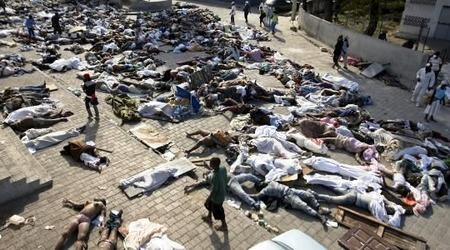







 « Tu me calcules, je te calcule. Quand c’est chaud sur nous ce n’est pas le Nigeria que nous regardons d’abord et ce n’est pas le Nigeria qui nous regarde. C’est bel et bien la France…Nous dirons Yako d’abord à ceux avec qui nous sommes fortement liés par l’histoire, la langue et l’économie….Et quand notre Assemblée Nationale avait brûlé, l’ambassade du Nigeria était toujours notre voisin mais c’est la France qui nous a aidés à sa réhabilitation…vraiment polémiquer pour polémiquer? » (Source First Magazine)


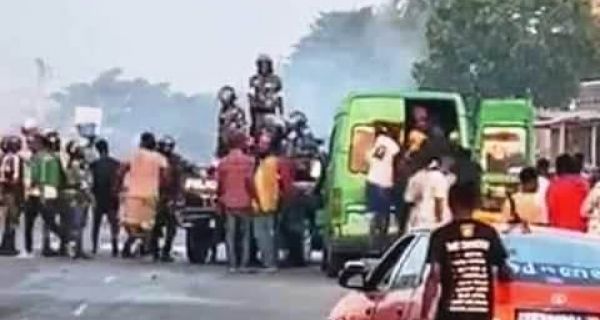

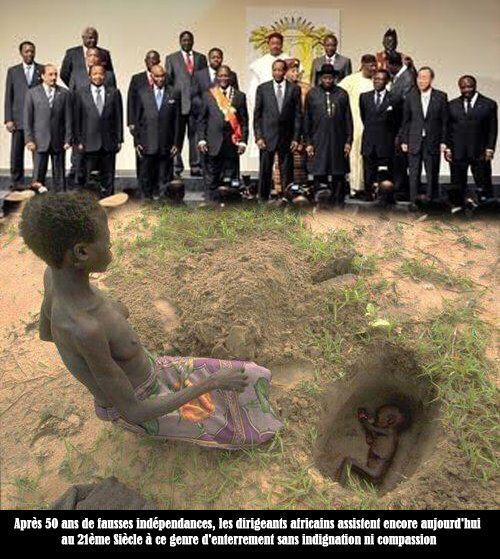



 Depuis quelques temps, le même mot est sur toutes les lèvres. Dans la rue, les salons privés, les lieux publics ; il court d’un bout à l’autre de l’échiquier politique…


 frindéthié